31 March 2006

Agricultural information and libraries in the Dominican Republic

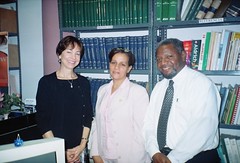
IAALD Executive Committee member, Barbara Hutchinson, accompanied by her daughter, Sydney, as translator, recently visited a number of libraries in the Dominican Republic. In the country’s historic and thriving capital, Santo Domingo, they saw not only the New World’s first church, hospital, university and the Museo de Hombre Dominicana which documents the early and extensive Taino Indian civilization, but the beautiful and highly electronic new library at the Universidad de Autonomia de Santo Domingo which will officially open in 2006.

They met with Teresa Romero, of the IICA Santo Domingo library, along with Senior Juan Freddy Armando, Director General of the Biblioteca Republica Dominicana.

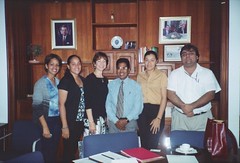
In addition, they met with the staff of the Information and Communications Division of the Centro para el Desarrollo Agropecuario y Forestal, Inc. (CEDAF), including Senior Cesar Amado Martinez, Gerente de Informacion y Comunicacion, and Gonzalo Morales, Enc. Publicaciones y Audiovisuales.

In particular, the visitors learned of the excellent work of CEDAF in developing and connecting nine regional agricultural research stations each of which include fully-operational information centers. These centers are located in rural areas and are operating much as extension services to the people in these communities. In the past, these services were largely provided through the Peace Corps. In recognition of their efforts, the Dominican government has provided additional funding to CEDAF. Besides supporting research activities, the CEDAF Information and Communications unit also organizes meetings, publishes proceedings, and provides weekly public relations articles to the three major newspapers in the Dominican Republic. These articles are prepared by two university student interns and demonstrate the close ties CEDAF has with the university community as well.

In Santiago, the country’s second largest city, they toured the beautiful library and campus of the Instituto Superior de Agricultura. The Institute’s library holds the largest collection of forestry materials in the country and a significant number of Dominican theses.

Some related web sites are: IICA Office in the Dominican Republic (www.iicard.org); CEDAF - (www.cedaf.org.do); Agora (http://www.agora.org.do) - includes access to the bibliographic database REDIAF; and www.infoagro.com - a web site from Spain with extensive agricultural information.


Tags:

Labels: , ,

30 March 2006

Digging in the dirt – ICTs and soil

The March 2006 issue of CTA's ICT Update features the application of information and communication technologies to soils (Les TIC et les sols).

Tags:

Labels:

29 March 2006

Pinoy farmers Internet blog - ICTs and agriculture in the Philippines

In recent months, we have seen a lot of ICT and agriculture activity in the Philippines. A blog from the Open Academy for Philippine Agriculture gives a wonderful introduction to their efforts to bring ICTs to rural communities and farmers. Right now, they are using buses to take ICTs to extension workers and farmers through the K-AgriNet ICT Roadshow.

The roadshow and blog are part of a wider portal where you can also find wikis, RSS feeds and swickis and social bookmarking with del.icio.us.

Tags:

Labels:

22 March 2006

AgInfo specialists from Armenia and Belarus join expert meeting at FAO

Agricultural information specialists from Armenia and Belarus recently participated in an expert consultation and training on agricultural information - FAO Depository libraries, AGROVOC and AGRIS. Hosted by FAO SEUR, they joined colleagues from Hungary and the Slovak Republic to share knowledge on the effective maintenance of FAO Depository Libraries and the establishment of AGRIS.

Tags:

Labels:

12 March 2006

Overcoming rural infrastructure barriers in Burkina Faso

The February 2006 issue of i4donline has an article by Francois Laureys of IICD in which he describes some projects in Burkina Faso in which ICTs are being used to advance rural livelihoods.

In one project, the Fédération Provinciale des Producteurs Agricoles de la Sissili, extension workers take digital pictures of crop problems and send them to researchers for advice and guidance. In another, ICTs are being being used by local communities to document, illustrate and promote more hygienic ways of using water. In a third case, the Institut Africain de Bio-Economie Rurale is using ICTs to broadcast and disseminate market price information via the combined use of television shows and the web.

Tags:

Labels:

08 March 2006

Filipino farmers to access agricultural information and technologies through SMS

According to a report in The News Today, farmers in the Western Visayas region of the Philippines can now access information through the use of cell phones or short message services (SMS).

The facility will be implemented through Farmers' Information and Technology Service (FITS) Centers and the Magsaska Siyentista (MS) program. FITS Centers are one-stop information shop hosted by local government units which aimed to improve access of farmers, traders, processors, entrepreneurs, and students to information and technologies in agriculture. Magsasaka Siyentistas are outstanding farmers who act as facilitators and initiators of technology development and transfer processes.

The FITS Centers and MSs will use cellular phones to bring the problems and concerns of farmers to the members of the Western Visayas Agriculture and Resources Research and Development Consortium and the Philippine Council for Agriculture, Forestry and Natural Resources Research and Development.

The use of SMS is part of the Knowledge Networking towards Enterprising Agricultural Communities programme - K-AgriNet which aims to improve access to information, modern technologies, indigenous knowledge by farmers, fisherfolk and agribusiness entrepreneurs through ICT.

Tags:

Labels:

07 March 2006

FAO launches IMARK e-learning module on information and its management

FAO has just launched the latest IMARK module entitled "Investing in Information for Development". It aims to support individuals responsible for formulating improved information management strategies within their organizations and through partnerships. The module covers information strategy formulation and implementation; information access; information dissemination; management issues like organizational capacity, partnership development, and staffing; and effective evaluation of information projects.

The module is available at no-cost through the IMARK website - www.imarkgroup.org.

Tags:

Labels: