26 April 2010

CGIAR centers join with Google Books to extend reach

In Montpellier today, CGIAR centers attending the IAALD Congress announced a new colaboration with Google Books.

CGBooks (http://books.cgiar.org), a collaborative effort involving CGIAR Information Managers, Web Managers and Google staff, has effectively expanded the reach of CGIAR research, simply by making publications instantly searchable over the Internet.

Labels: , , , , , ,

17 March 2010

Brasil: Serviço de Respostas Técnicas quer ampliar acessos

Serviço Brasileiro de Respostas Técnicas (SBRT), em que especialistas respondem gratuitamente a perguntas de qualquer natureza enviadas por pessoas físicas ou jurídicas. A diversificação, ampliação do número de acessos e divulgação desse site de informação.

O último levantamento mostrou que 80% das perguntas dizem respeito ao agronegócio e à alimentação. Na reunião, técnicos de diversas áreas do Sebrae discutiram estratégias para que as dúvidas mais frequentes alimentem o banco de dados de forma contínua. Sofisticar o sistema de busca e aumentar o número de dossiês técnicos são algumas das propostas para divulgar e aprimorar este serviço.

O serviço pode ser acessado pelo endereço http://www.respostatecnica.org.br.

Labels: , , , , , , ,

29 January 2010

Web publishing for research impact at CIAT

This 2007 poster reports on ways that CIAT in Colombia shares research tools and results. Check out other postings on research communication at CIAT.

Labels: , , , ,

12 January 2010

Acceso Abierto y Repositorios Abiertos en el CIP y el CGIAR

Hablando en la Reunión RIBDA 2009 en Lima, Cecilia Ferreyra del CIP - el Centro Internacional de la Papa – explica la importancia de los repositorios instituciones y el acceso abierto en su instituto.


Acceso Abierto - RSS

Labels: , , , , , ,

07 January 2010

Abriendo el Acceso al conocimiento del CGIAR

Exponiendo en la Reunión RIBDA 2009 en Lima, Edith Hesse del CIAT explica porqué el acceso abierto es importante para el CGIAR y algunos pasos concretos que pueden tomarse para asegurar que los resultados de la investigación sean disponibles y accesibles.


Acceso Abierto - RSS

Labels: , , , , , ,

06 January 2010

Opening access to the CGIAR's knowledge

Speaking at the RIBDA 2009 meeting in Lima, CIAT's Edith Hesse explains why open access is important to the CGIAR, and some concrete steps that can be taken to ensure that research outputs are available and accessible:


Open access - RSS feed

Labels: , , , , , ,

09 December 2009

Using GIS in biodiversity conservation across South Africa

The South African National Biodiversity Institute (SANBI) promotes easy and open access to biodiversity information. Through its Biodiversity GIS website it provides free access to biodiversity plans, maps and tools to support research, planning and decision-making.

Read more ...

Labels: , , , , , ,

26 November 2009

Chile: FIA presenta en Valdivia su Plataforma I+D+i

Fortalecer la competitividad de la agricultura, a través del desarrollo de contenidos aportados por distintas entidades nacionales e internacionales proveedoras de información, es el objetivo central de la Plataforma I+D+i Servicios de Información para la Agricultura, que la Fundación para la Innovación Agraria (FIA) tiene operando y que presentará este jueves 26 de noviembre en Valdivia.
La Plataforma, a la que se puede acceder a través de Internet en el sitio www.innovacionagraria.cl, integra bases de datos especializadas con información de mercado, legislativa, técnico-productiva y agrometeorológica.

El sistemas tiene como una de sus principales fortalezas el permitir, desde un solo lugar, el acceso a toda la información unificada y articulada del sector silvo-agropecuario chileno, bajo criterios comunes de búsqueda y manejo de la información.

De esta manera, la Plataforma I+D+i permite explorar, identificar, capturar, procesar y aprovechar de manera eficiente y rápida toda la información generada y administrada por los servicios del Ministerio de Agricultura, más otras instituciones del sector, tales como centros de información, bibliotecas, fundaciones y universidades del país y el extranjero, que contribuyeron con esta iniciativa liderada por FIA.

La Plataforma interactúa y brinda soluciones en tiempo real a los usuarios en línea, y al mismo tiempo, guía y entrega respuestas off line a problemáticas locales y desafíos de más largo aliento, permitiendo el acceso a través de distintos soportes dependiendo del público objetivo (consultas en línea, CD, papel, atención telefónica, vía celulares y otras).

La presentación en Valdivia, contará con la asistencia del Seremi de Agricultura, Javier Parra, y la Jefa de la Unidad de Información y Difusión de FIA, Francine Brossard.

Lea el artículo completo.

Labels: , , , , , , ,

13 November 2009

Communicating a new research output: IFPRI strategies

What does it take to create a buzz around a new research output? Luz Marina Alvare and Chris Addison share some insights into the communication and knowledge-sharing approaches followed by IFPRI in launching a new book: Millions Fed: Proven Successes in Agriculture.

This project has numerous audiences - media, agriculture and development policy workers, researchers and the public – and we had to create a suite of products that all of them could embrace while still meeting the needs of each group. To achieve this, we had to integrate the different media approaches and products from each communication unit and research area into one campaign.

The core products are a book describing 20 cases from around the world showing success stories backed up by a series of discussion papers with case studies illustrating evidence that the interventions worked.

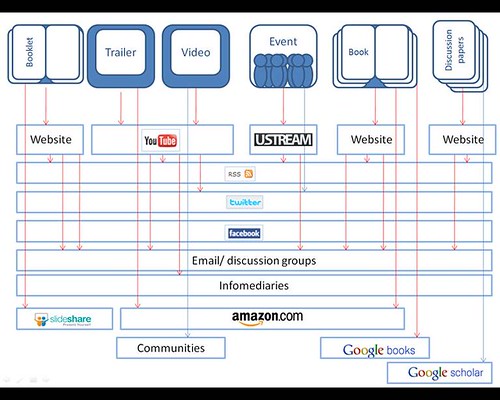
To communicate these issues to a broader audience and reinforce the communications process, we developed three further products:

a booklet highlighting the project as a whole and some of the key findings

a video trailer to accompany the book and draw attention to it

a full video summarizing the book as a whole and providing the most powerful presentation of key messages

Our plan - outlined in the diagram below - uses a variety of products to promote the key messages and generated various new products [click on the image for larger size].

click for larger size

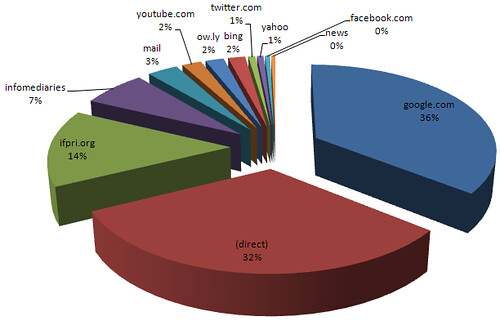
Following an analysis of the take up of recent IFPRI products, we confirmed our thinking that traditional Web channels are the most important for many of the audiences. The Web site is used as the main repository of the products and we measure Web site traffic to understand the effectiveness of our efforts. Using the title of the project ensures good indexing in Google and our own Web site features the products in key locations. Email campaigns appear to be the next most successful in bringing visits, not only through online email but also via direct visits from local email partners.

Looking ahead, we see great potential in using infomediaries to promote to communities we cannot reach directly. Social media is also increasingly important.

Below is a snapshot of sources of overall visits prior to the media launch of the book [click on the image for larger size]:

click for larger size

We are monitoring our activities during the official media launch and will provide a follow up story of our findings on what worked and what didn’t. At the end of November, we will review how the product has been taken up through the Web, which approaches proved most valuable and review lessons learned.

---
'Millions Fed' aims to identify and examine successes in agricultural development and provide insights into the lessons they offer. The Bill & Melinda Gates Foundation (BMGF) called upon the International Food Policy Research Institute (IFPRI) to assess the evidence on what works in agriculture -- what sorts of policies, programs, and investments in agricultural development have actually reduced hunger and poverty.

Labels: , , , , , ,

08 November 2009

Towards a DFID Research policy on open access

The UK's Department for International Development (DFID) is a major funder of agricultural and development research. A recent news item in R4D reposrts that DFID "supports Open Access as a core component of its research commitment to ensure that research knowledge can be accessed, built upon and used in support of the objectives of the DFID Research Strategy."

A recent scoping study [by Peter Ballantyne] has looked at how DFID Research can develop an open access policy that will lead to greater public access to the research outputs it finances. Read the report 'Towards a DFID Research Policy on Open Access' and see the presentation based upon this report.

More: open access / see also CGIAR 'triple A' approach to these issues / CIARD - making research information truly accessile.

Labels: , , , , , ,

29 October 2009

Disponibilidad, accessibilidad y aplicabilidad de los resultados de investigación de los Centros del CGIAR

En la XV RIBDA que celebrandose del 27 al 29 de octubre en Lima, Peru, Edith Hesse del CIAT presentó datos preliminares de un estudio sobre accesibilidad del los resultados de investigación del CGIAR.

Labels: , , , , , , , ,

CIARD 'RING' maps AgInfo services and providers in research

Developed by GFAR as part of the CIARD initiative, the new CIARD RING - or Routemap to Information Nodes and Gateways - is "a registry of existing information services for agricultural research for development, indexed and described in a way that makes them more easily exploitable for building value-added integrated services."

The new RING is still in beta and it needs service providers to register their sites. Give it a try and help us build a foundation for more accessible aginfo exchange.

Labels: , , , ,

28 October 2009

Making information accessible: Good practices and pathways

After many months preparation and gestation, CIARD has published a revised Checklist of Good Practices in disseminating research information (see also the manifesto: Towards a Knowledge Commons on Agricultural Research for Development).

Several draft CIARD Pathways have also been made available to explain and illustrate how research outputs can be made more available, accessible and applicable. These capture good practices from around the world.

The pathways are clustered in three groups: Group 1, called 'Developing Institutional Readiness' focuses particularly on areas of change in both policy frameworks and individual researcher behaviour. Group 2 on 'Increasing the Availability and Accessibility of Research Outputs – Collection and Preservation' focuses on technical and policy approaches to ensure that websites/repositories fulfil their purpose of making research outputs more accessible and available. Group 3 pathways look beyond websites and repositories and are focused on 'Increasing the Availability and Accessibility of Research Outputs – Making Content Widely Accessible on the Web.'

Comments and feedback on individual pathways are invited (login is required).

Labels: , , , ,

27 September 2009

Information, knowledge and communication in the new CGIAR strategy

The international agricultural research system of the CGIAR is undergoing a large transformation. A recent Progress Report No. 4 "presents interim findings and proposals of the Strategy Team for review and discussion."

The proposed 'Strategy and Results Framework' introduces seven interlinked Mega Programs and two platforms — gender and capacity strengthening - that will serve as the building blocks for the work of the 'new' CGIAR.

How do information, knowledge, ICTs and related areas fare in these proposals?

Mega-Program 3 is titled 'Institutional Innovations, ICTs, and Markets.' Its focus will be on: "Knowledge to inform institutional changes needed for a well-functioning local, national, and global food system that connects small farmers to agricultural value chains through information and communications technologies and facilitates policy and institutional reforms."

This mega program "aims to unleash an ― institutional and information revolution - with and for farmers and the rural poor that improves and secures their livelihoods, and also promotes innovation along value chains." It speculates that the "next big breakthrough in institutional innovation to be unleashed in support of poverty reduction, food and nutrition security, and environmental sustainability" might include: "linking of information and communications technologies (ICTs) to value chains and services for the poor in rural areas, through, for example, the cell phone and its increasing range of sophisticated derivatives."

Within Mega Program 1 on 'Crop Germplasm Conservation, Enhancement, and Use', a program is envisaged to "integrate bioinformatics and crop information systems."

These proposals seem to recognize the importance of knowledge and information as well as ICT applications and tools within both CGIAR research processes and the agricultural nnovation systems where organizations doing research and development interact. Hopefully, it will boost scattered efforts to increase research uptake, interaction and collaboration using ICTs and other innovative approaches to knowledge sharng and communication. It would usefully also emhpasize the potential for co-creation of knowledge and information among the partners.

The cross-cutting 'capacity-building platform' will "strengthen the capacity of the CGIAR and its partners through improved research networks, information technology, knowledge management systems, and training. The expected result is a dynamic knowledge creating and -sharing system comprising CGIAR centers, strong independent national agricultural research systems, and other research partners sharing knowledge."

The capacity strengthening role of the CGIAR is recommeded to "have two purposes: strengthening capacity for all Mega Program partners by fostering research collaboration and networking, and strengthening capacity for weak national agricultural research systems."

"An important element of both activities will be the development and use of advances in information and communication technologies (ICTs) and knowledge management and innovation systems, including access of Mega Program partners to applications and resources such as databases."

These proposals seem to include work by CGIAR centers to make their data, information and knowledge accessible (see recent work on AAA and CIARD), so often limited-access knowledge is freed to be exchanged and re-used. Hopefully, they will not forget the importance of open licenses such as creative commons, and open access in general. The 'public goods' need to be made public!

Under a heading 'Communications Strategies,' the document also argues that "research programs have no impact without communications: innovations, research results, policy assessments, and policy recommendations are useless if they are not communicated to those who can use them."

They suggest an 'umbrella communication strategy' that will "make clear what the CGIAR’s vision means in concrete terms and what the new CGIAR will do to achieve its visionary goals."

Each Mega Program will therefore have a "defined communications strategy that outlines the key messages to be conveyed, the key target groups, and the media and channels for communicating with the key target groups." To maximise synergies, "the mega program communications strategies will be coordinated with the umbrella communications strategy for the vision."

Building communications - as well as information access and knowledge sharing - into each Mega Program seems very sensible. Let's hope the designers adopt the DFID Research approach that calls for 30% of a project's funding to be be allocated to communication and uptake.

Labels: , , , , , , ,

09 September 2009

Open access to Australian research outputs through relaunched AANRO

The redeveloped AANRO database is launched in Canberra Australia on 9 September.

Designed as a national single entry point to agriculture and natural resource management research information, Australian Agriculture and Natural Resources Online (AANRO) makes the outputs of publicly funded research readily available and sets a new standard in open access for agriculture and natural resource management.

It has been developed as a collaborative effort between the 14 rural research and development corporations, the Primary Industries Standing Committee and Natural Resource Management Standing Committee members. This involves more than 36 partner organisations. There has also been considerable investment by the Climate Change Research Strategy for Primary Industries (CCRSPI) partners.

AANRO includes three major databases which are linked – a research in progress database, a researcher profile database (to enable person to person contact), and a final research report database.

---
Source: Pam Cunningham, AANRO Manager, Land & Water Australia, www.lwa.gov.au

More postings on: Aginfo Australia; open access

Labels: , , , , , , ,

03 July 2009

CIARD research accessibility news

Stephen Rudgard of FAO recently shared some information on the CIARD initiative.
  • Regional Workshop with AARINENA: AARINENA called a regional workshop of information specialists from national agricultural research services in its member countries, which was held in Cairo in May 2009. One day of this workshop was allocated to introducing and discussing the CIARD agenda with the colleagues from national institutions, with facilitation provided by Ajit Maru of GFAR, Nihad Maliha of ICARDA/CGIAR, and Stephen Rudgard of FAO.
  • CIARD Pathways: In addition to the Manifesto and Principles, now published on the CIARD website, a CIARD Checklist and set of Pathways are being developed. The Pathways are being identified and drafted by a joint working group comprising the CIARD Content Management Task Force and an ad-hoc group comprising representatives of some of the members of the Advocacy Task Force. Good progress has been made to date, with around half of the pathways available at least in draft form. A small "writeshop" was convened in late May at the headquarters of Bioversity International in Rome, bringing together a few of the people involved in the drafting exercise. In due course, an area of the website will be opened where the Checklist and Pathways will be available for comment and input, and we will inform you of this as and when appropriate.
  • Capacity Building in CIARD: In association with the IMARK Steering Group held recently at CTA headquarters, a short impromptu meeting was organized with some of the CIARD partners to have an initial discussion on the role and justification of a CIARD Capacity Building Task Force (CBTF), which has long been foreseen but not yet activated. 
IAALD is a partner in the CIARD initiative

Labels: , , , , ,

02 July 2009

Research4Life website launched today

In London this morning, the Research4Life partnership website was launched at the World Conference of Science Journalists.

Research4Life is the collective name given to HINARI, AGORA, and OARE, the three public-private partnership programs of the WHO, FAO, UNEP, Cornell and Yale Universities and the International Association of Scientific, Technical and Medical Publishers.

Speaking in London today, Andrew Plume (Associate Director of Scientometrics and Market Analysis at Elsevier) showed data suggesting that Research4Life has a "profound impact on the scholarly landscape" in the countries where the partnership is active.

His analysis of data from the Thomson Reuters database shows a "dramatic rise in research outputs by scientists in the developing world since 2002." The study compared growth in research outputs for the periods 1996-2002 and 2002-2008 - before and after HINARI was launched.

His data showed growth of research publications in countries that are 'non-eligible' for Research4Life to be 67% in the 2002-2008 period. In the same period, Research4Life 'Band 1' countries (institutes get free access) reported 145% growth while 'Band 2' countries (institutes pay a small fee) reported 194% growth.

According to Plume: "We can attribute this, at least in part, to the provision of literature through the Research4Life programme."

It seems that these initiatives are improving the abilities of scientists from developing countries to publish in international peer-reviewed journals.

Note: the analysis is based on peer reviewed publications outputs in the Thomson Reuters database and does not include other factors such as changes in levels of research funding, improved connectivity, or efforts of other initiatives. [See also critical blog post]

The video explains how Research4Life helps researchers in Kenya:


More videos from research4Life

Labels: , , , , , , ,

24 June 2009

El proyecto de Biblioteca Virtual del CGIAR

Carlos Saa, Coordinador de Sistemas de Información en la Biblioteca del CIAT, presenta el proyecto de Biblioteca Virtual del CGIAR (CGVLibrary) y porqué es importante para el CIAT.


La CGVLibrary - http://vlibrary.cgiar.org/

La biblioteca CIAT - www.ciat.cgiar.org/biblioteca/biblioteca_es/

Labels: , , , , , ,

11 June 2009

Communicating swine flu research - Evidence for open access models?

Through Twitter, just came across fascinating blog post from leading science writer and blogger Carl Zimmer...

In his posting, he describes his positive experiences trying to obtain information on swine flu science.

Concluding that "the patient process of old-fashioned science publishing may have to be upgraded", he show how scientists working on the virus created an open wiki (thanks to them for the image on this posting) to share information - "So everyone who wanted to peruse their analysis could see how it developed as more data emerged and as they used different methods to analyze it."

After this open process, it seems the results were published (today 11 June) in Nature - with a Creative Commons license.

Of course, this openness may be due to the urgent nature of the problem. But it does show a different - and open - way to do science. This model combines open 'social' media like wikis and blogs with publishing in a traditional peer-reviewed journal, and the use of creative commons licenses to maximise access to the results.

It sounds like several of the promising pathways CIARD aims to pull together to make agricultural research outputs more accessible!

Labels: , , , , , ,

10 June 2009

Knowledge management principles for natural resources management

Last month, we shared some data management principles for natural resources management. This month, we look at some KM principles from the Regional Knowledge Resource Kit - a wiki resource for managing information and knowledge for natural resource management in Australia. Also produced by Land & Water Australia, the principles they suggest are:
  • Share what you know and help others learn.
  • Has this been done before? Don’t reinvent the wheel!
  • Collaboration.
  • Synthesis - transfer knowledge concisely rather than overloading your audience.
  • Learning.
  • Team work.
  • Innovation / creativity.
  • Use networks of expertise.
  • Promote knowledge champions.
  • Language - make sure it is appropriate to the audience.
  • Knowledge is volunteered, never conscripted.
  • We know more than we can say, and we say more than we can write down.
  • We only know what we know when we need to know it.
  • Being well connected. The Paul Revere story provides a good example why.
See the Resource Kit

Labels: , , , , , , ,