06 July 2012

Communicating agricultural biotechnology

The International Service for the Acquisition of Agri-biotech Applications (ISAAA) has released several interesting reports and news items on crop biotechnology and its communication.

These include:


  • Communicating Agricultural Biotechnology in Africa: What Role for Radio? - Download the brief

  • Communication Challenges and Convergence in Crop Biotechnology - Download the book 

  • Bridging the Knowledge Divide: Experiences in Communicating Crop Biotechnology - Download the report

More from ISAAA

Labels: , , , , ,

23 May 2011

Sus investigaciones son comunicadas efectivamente? Comparta su opinión

Un gran desafío que enfrentan los investigadores actualmente es cómo comunicar sus resultados de investigación de manera más efectiva.

El CGIAR (Grupo Consultivo Internacional para la Investigación Agrícola), la FAO (Organización de las Naciones Unidas para la Agricultura y la Alimentación) y el GFAR (Foro Mundial para la Investigación Agraria) están llevando a cabo un estudio global para reunir evidencia de los investigadores sobre los beneficios potenciales y preocupaciones de una comunicación más amplia de los resultados de sus investigaciones, y promover vías innovadoras para que puedan compartir mejor sus resultados.

Esta breve encuesta está destinada a investigadores y científicos que trabajan en el ámbito de la agricultura, ganadería, silvicultura, pesca, alimentación y nutrición, y otras que estén vinculadas con las anteriores en ámbitos como biología, medio ambiente, economía y disciplinas sociales. Su participación en ésta encuesta es sumamente valiosa, e instamos a compartir nuestra invitación con otros colegas y pares en los ámbitos mencionados.

Comparta su opinión en este breve cuestionario : http://surveymonkey.com/s/ciard-investigador

Esta encuesta es parte de un estudio sobre CIARD (coherencia en la información agrícola para la investigación para el desarrollo).

Labels: , , , , ,

Les résultats de vos recherches sont-ils communiqués efficacement? Donnez-nous votre avis!

Un des plus grands défis pour les chercheurs aujourd'hui est de communiquer les résultats de leurs recherches plus efficacement.

Le GCRAI (Groupe consultatif pour la recherche agricole internationale), la FAO (Organisation des Nations Unies pour l'alimentation et l'agriculture) et le GFAR (Forum mondial de la recherche agricole) réalisent une enquête auprès des chercheurs du monde entier sur les avantages et inconvénients potentiels liés à une communication de leurs résultats à plus grande échelle, afin de promouvoir des moyens innovants pour un meilleur partage de ces données.

Cette enquête s’adresse aux chercheurs spécialisés dans l’agriculture, l’élevage, les forêts, la pêche, l’alimentation et la nutrition, et les domaines biologiques, environnementaux, économiques et sociaux apparentés. Votre participation serait très appréciée, et nous vous encourageons à faire suivre cette invitation à vos collègues et pairs qui travaillent dans les disciplines concernées.

Faites-nous connaître votre avis en participant à cette courte enquête: http://surveymonkey.com/s/ciard-chercheur

Cette enquête s’inscrit dans le cadre d’une étude de CIARD (Cohérence de l'information sur la recherche agricole pour le développement).

Labels: , , , , , ,

Is your research being communicated effectively? Share your views

A major challenge faced by researchers today is how to communicate their research outputs more effectively.

The CGIAR (Consultative Group on International Agricultural Research), FAO (Food and Agriculture Organisation of the United Nations) and GFAR (Global Forum on Agricultural Research) are conducting a global survey to gather evidence from researchers on potential gain and concerns of a wider communication of research results, and promote innovative pathways for better sharing their outputs.

This survey is intended for researchers working in agriculture, livestock, forestry, fisheries, food and nutrition, and related biological, environmental, economic and social fields. Your participation in this survey is very valuable, and we also want to encourage you to extend this invitation to other colleagues and peers working on the disciplines mentioned.

Share your views by taking a short survey: http://surveymonkey.com/s/ciard-researcher

This survey is part of a study on CIARD (Coherence in Information for Agricultural Research in Development).

Labels: , , , , ,

07 February 2011

Integrated approaches to development action through communication strategies

A side event at this weeks IFPRI conference 'Leveraging Agriculture for Improving Nutrition and Health' looks at ways that "communications can help bring agriculture, nutrition, and health closer together."

Download the background paper by Warren Feek who argues:

"When looking at the question of leveraging agriculture for improved nutrition and health from a communication perspective, it is vitally important to clarify where the main challenges lie. The problem is not at the community level; the issue is how international development action is organized overall.

Development efforts can benefit greatly from 1) prioritizing a set of communication processes that ensures that the voices, ideas, perspectives, and plain common sense of people in local communities are included and amplified, and 2) promoting effective communication among development stakeholders in order to enhance coordination and cooperation across different vested interests and issues.

Action based on these two processes will generate the greatest outcomes; through effective communication, the efforts and energies of development agencies and local populations will result in accelerated action that breaks down unhelpful divisions, including those among agriculture, nutrition, and health."

Labels: , , , , ,

12 November 2010

Communication and extension services at the 2010 Tropentag

The 2010 Tropentag meeting in September mobilized a number of interesting presentations and posters on communication and extension in agriculture - the abstracts are online, and include:

  • Learning through Moving Pictures: Farmer-to-farmer Video to Stimulate Farmers' Innovations about Botanical and Alternative Pest Management Practices in Bangladesh


  • "Aid-infoservice Germany": A Success Model for the Development Cooperation


  • Potential of Posters as Visual Pictorial Aids in the Process of Health and Nutrition Counselling in Cameroon


  • Capacity Development as a Bridge to Transform Scientific Knowledge into Action for the World Food System


  • Role of Agricultural Extension Agents (AEAs) in Syrian Drylands


  • Influence of Public and Private Agents in the Use of new Knowledge and Technology among Small-scale Producers: The Case of the Honduran Coffee Chain


  • Impact of Dissemination Pathways on the Probability and Intensity of "Push Pull" Technology Uptake in Western Kenya


  • Research Spillover: Quantification Methods and Recent Experiences in ICRISAT Groundnut Research

Labels: , , , ,

29 April 2010

Strategic communication: from technologies transferred to empowered farmers

According to Phouttasin Phimmachanh of the Laos NAFES, adoption of strategic communication approaches has helped transform the effectiveness of research and extension in Laos.

He started by explaining how agriculture in Laos is generally moving from a subsistence to a market led environment, and that this poses information and decision making challenges for everyone involved in the sector - farmers, extension and research, and policy makers.

The main focus of his presentation was on strategic communication processes they recently adopted.

Two of the key reasons they adopted this approach:

First, communictaion materials were often developed in a top down way - "to meet the needs of the boss or the needs of the project", rather than to meet the needs of farmers. Second, these materials were often promotionsal rather that educational.

He characterized this past experience as "just producing without knowing where it goes and whats the impact of it."

He characterized the new approach: "so now we try to produce differently and to better communicate with farmers." This new approach is systematic, strategic, it draws in multidisciplinary research-extension-farmer teams, is designed and tested with target users, and involves better M&E.

One of the key lessons: "the communications process is not any more about transferring technologies, it is about empowering farmers to make their own choices"

See his presentation:

Labels: , , , , , , ,

30 December 2009

Farmsphere - the food and agribusiness meeting point

Farmsphere is a platform designed to mimic the natural way in which agribusiness professionals meet and do business in a faster, cheaper, more efficient way.

Farmsphere accomplishes this through its own website and by enabling individuals and organizations around the world to create their own branded online professional communities.

Read more ...

Labels: , , , , ,

13 November 2009

Communicating a new research output: IFPRI strategies

What does it take to create a buzz around a new research output? Luz Marina Alvare and Chris Addison share some insights into the communication and knowledge-sharing approaches followed by IFPRI in launching a new book: Millions Fed: Proven Successes in Agriculture.

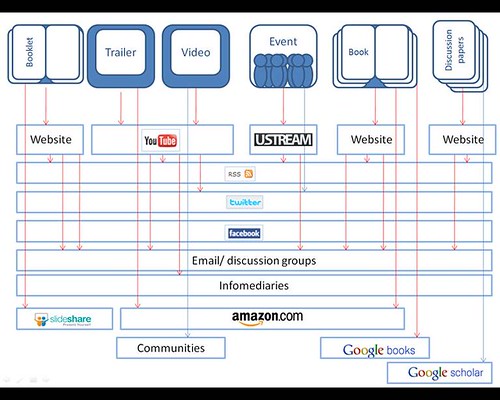
This project has numerous audiences - media, agriculture and development policy workers, researchers and the public – and we had to create a suite of products that all of them could embrace while still meeting the needs of each group. To achieve this, we had to integrate the different media approaches and products from each communication unit and research area into one campaign.

The core products are a book describing 20 cases from around the world showing success stories backed up by a series of discussion papers with case studies illustrating evidence that the interventions worked.

To communicate these issues to a broader audience and reinforce the communications process, we developed three further products:

a booklet highlighting the project as a whole and some of the key findings

a video trailer to accompany the book and draw attention to it

a full video summarizing the book as a whole and providing the most powerful presentation of key messages

Our plan - outlined in the diagram below - uses a variety of products to promote the key messages and generated various new products [click on the image for larger size].
click for larger size

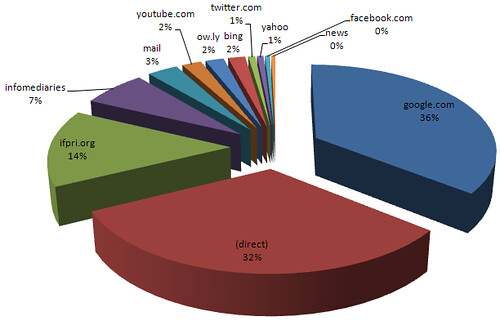
Following an analysis of the take up of recent IFPRI products, we confirmed our thinking that traditional Web channels are the most important for many of the audiences. The Web site is used as the main repository of the products and we measure Web site traffic to understand the effectiveness of our efforts. Using the title of the project ensures good indexing in Google and our own Web site features the products in key locations. Email campaigns appear to be the next most successful in bringing visits, not only through online email but also via direct visits from local email partners.

Looking ahead, we see great potential in using infomediaries to promote to communities we cannot reach directly. Social media is also increasingly important.

Below is a snapshot of sources of overall visits prior to the media launch of the book [click on the image for larger size]:
click for larger size

We are monitoring our activities during the official media launch and will provide a follow up story of our findings on what worked and what didn’t. At the end of November, we will review how the product has been taken up through the Web, which approaches proved most valuable and review lessons learned.

---
'Millions Fed' aims to identify and examine successes in agricultural development and provide insights into the lessons they offer. The Bill & Melinda Gates Foundation (BMGF) called upon the International Food Policy Research Institute (IFPRI) to assess the evidence on what works in agriculture -- what sorts of policies, programs, and investments in agricultural development have actually reduced hunger and poverty.

Labels: , , , , , ,

22 October 2009

Online guide to scientific writing

Supported by the Commonwealth Forestry Association, this guide aims to help authors get their manuscripts published in recognized journals. It has been put together by the Editor of the International Forestry Review and draws on work carried out by Fahamu, the Journal of Environmental Management, and the Tropical Agriculture Association.

Labels: , , , , , ,

23 September 2009

Bolivia: dudas sobre la compra de satélite para mejorar conectividad rural

Un artículo publicado en Bolivia informa que la decisión del Gobierno de adquirir un satélite propio es cuestionada por especialistas en tecnología. Consideran que la inversión no se justifica para una demanda de servicios muy limitada.

Además, dicho artículo indica que el presidente Evo Morales ha dicho que Bolivia cuenta con 36 poblaciones indígenas, por lo que un moderno sistema de telecomunicaciones, con acceso a Internet, es fundamental para afrontar los retos de la pobreza, la exclusión y el aislamiento, en particular de las poblaciones indígenas. “Ese acceso les daría medios modernos para salir de la pobreza, facilitar su integración, aumentar su productividad, mejorar sus condiciones de enseñanza, facilitar la transferencia de tecnología y obtener servicios sociales”, según declaró el Presidente.

Lea el artículo completo

Labels: , , , , , ,

16 September 2009

EVA Radio en Colombia: Emisora Virtual Agropecuaria de CORPOICA

La programación de este nuevo medio de comunicación digital complementa la actividad de transferencia de tecnología que desarrolla CORPOICA. -Podcast, audiobooks, magazines, noticias y Chat figuran entre los servicios informativos que se transmitirán 24 horas al día.

A la vanguardia de las nuevas tecnologías de la información y la comunicación, TIC, CORPOICA puso en funcionamiento a través de su sitio Web la Emisora Virtual Agropecuaria, EVA Radio, cuya programación está orientada a divulgar y transferir los resultados de la investigación e innovación que desarrolla la Corporación para el sector agropecuario nacional.

Lea el artículo completo

Labels: , , , , , , ,

02 September 2009

Creating a web-based virtual community in forestry

With examples from the forest sector, Eva Haviarova and Richard P. Vlosky "break down the general steps required to ideate, create, and launch a successful on-line generic Internet-based community."

Their conclusions: "Building a Web community requires a lot of planning. The recipe for building a Web community given here is very generic in nature. Although examples were for building a Web community for the forest industry, the process can be used for any industry with only relatively minor changes.

In building a Web community, one has to be always aware of why it is being built and how it will be successful. Once a Web community is successful, the next step might be to introduce a notion of carrying out e-commerce through the Web community. Another area would be inventory management to enhance and make efficient the entire supply chain of the industry. These steps would depend upon the level of success and commitment by the industry members."

Labels: , , , , , ,

22 August 2009

Agri-media use by farmers: Radio still on top

The National Association of Farm Broadcasting (NAFB) in the US recently carried out a 'wave study' of agri-media use by large-scale farm producers.

According to the press release "Large-scale commercial agricultural producers value radio most for daily agribusiness information." Furthermore, "the Internet has definitely become an important part of the producer's information sources; but the traditional ag media mix of print, radio, and television (ag/rural programming) is the most quantifiable and identifiable way to reach the producer on both a broad level, as well as a daily level."

In an interview for Agri Marketing, NAFB Executive Director Bill O'Neill is quoted: "Information-on-demand and its ready accessibility - an inherent advantage for radio - clearly matters more and more. Among many producers, valued information is being received daily from texting services and by Web-enabled cell phones, as well as via traditional media."

Press release (PDF)
Executive summary (PDF)

Labels: , , , , , , , ,

19 July 2009

Putting public AgInfo to use requires repackaging, transformation, and innovative partnerships

Accra, 17 July 2009: In a video interview with FARA, IAALD president Peter Ballantyne reflects on some discussions at the IAALD Africa conference in Accra.

Asked for a 'take home' message, he referred to a discussion on mobile agriculture and market information systems where speakers from private enterprises referred to the difficulties they have to find the essential information and content their customers will pay for. Their remarks suggest that public content creators and providers need to question their assumptions, particularly the notion that they have 'the' valuable content that others need to reach farmers.

For the private companies to "really put this [public] information to use, they have to repackage it, re-create it, start from scratch ... so are we in fact sitting on all those huge mountains of valuable information; do we have to pay much more attention to the re-use, repackaging, the transformation, really innovative ways of working in partnership with these private organizations."


He was interviewed by Francois Stepman of FARA

More FARA video interviews

Labels: , , , , , , ,

10 July 2009

Media, ICTs, extension to accelerate agriculture in South Asia

This week, the SAARC Agriculture Centre held a workshop to discuss ways to strengthen linkages among research, extension, farmer and marketing through improved use print and electronic media in SAARC Member States.

The discussions were picked up in regional media:
  • The News (Pakistan) reported that the experts "stressed the need for the establishment of the first agriculture e-chamber, besides utilising information and communication technologies to promote the agriculture sector in the region." Dr Qadir Bux Baloch, Agriculture Development Commissioner of Pakistan's Ministry of Food and Agriculture referred to a series of websites to be set up - see www.agroleadclub.com. He further "called for extending all kinds of support to the media to facilitate transfer of technology from research institutes to farmers."

  • South Asia Media Net reported interventions by agricultural experts from Bangladesh, Bhutan, Bangladesh and India. Md.Nazrul Islam from Bangladesh suggested to develop agricultural technology related farmers friendly contents for disseminating through ICT facilities and community based information centers; he also recommended the use of tools like mobile, CD, and Web to transfer technology at the village level - ensuring that agriculture technologies and information will be available at the "door-step of the farmers."

Download workshop paper - PDF

Labels: , , , , , , , , ,

01 July 2009

Science communication and science journalism

In London this week, some 900 people have signed up for the 6th world conference of science journalists.

There is a wide range of presentation and discussions - looking at mainstream science communication, journalism, and the use of new media.

As well as the WCSJ news site, an especially good place to follow the discussions is on Twitter – http://twitter.com/#search?q=wcsj

See also the excellent Nature magazine special on science journalism as well as blogs from SciDev.net and by Angela Saini.

Labels: , , , , ,

23 June 2009

Farmers joining the conversations on food in many ways

Farm Bureau farmer and rancher members hand out the stickers to people as they talk with them about food and agriculture at fairs, festivals, farm tours and community events.The popularity of these simple stickers points to a hunger among consumers (who are on average, three generations removed from farming) for information about the food they eat, where it comes from and who produces it.

And, America's farm and ranch families are more interested than ever in reaching out to consumers to talk about the food they grow and the art, science and business of farming. Individual producers do this in person, online or both.

Online, recent posts to the AFBF's FBlog by farmers and ranchers explore a variety of food-related topics including, "The Real Story of Ag," "Food, Inc.," "Helping Hands and Good Conversation" and "Family Farmers Produce Safe Food."

Also online, the micro-blogging social media tool Twitter offers a new twist on finding concise consumer-friendly information on just about any subject, including food and farming. If you're using Twitter, search for #foodfact, #foodandfarmfact and #farm to find 140-character messages sent by all types of farmers, ranchers and growers.

Despite the pervasiveness of electronic communication, when meeting face-to-face, most producers still prefer to offer printed resources that people can hold in their hands to help tell the story of modern farm and ranch production.

One example is the "Food and Farm Facts" book (previously "Farm Facts") and a smaller pocket guide version produced by the American Farm Bureau. These printed materials highlight today's modern agriculture. Other excellent printed resources with state-specific agricultural information also are available from most state Farm Bureaus.

Read full article.

Labels: , , , , , , , ,

19 June 2009

Radio and video help trigger rice innovation in Africa

The Africa Rice Center (WARDA) is using radio and video to get information about improved technologies and market opportunities.

An article in the International Journal of Agricultural Sustainability shows how "farmer-to-farmer video has great potential to enhance sustainable agriculture by encouraging local innovations."

More:

Labels: , , , , , , , ,

13 June 2009

Communicating research findings to rural people

The DFID-supported Research Into Use Programme (RIU) has published a collection of stories (PDF format) that show how information information about new ways of doing things is communicated to rural people in developing countries.

The authors argue that these success stories demonstrate the importance of having an appropriate strategy. "In each case, the people who had a message they wanted to communicate carefully ... They painted a clear picture of their target audience and found out, often by doing research, who or what they listened to, looked at, read and trusted. They also looked for communication professionals who could help craft messages that would 'push the right buttons' with the audience ... They realised that they would need a variety of partners, and looked around to find and team up with them."

This last issue - partnership and a recognition of the role of various intermediaries - is indeed critical and is picked up again by the authors in the conclusion to their introductory article:

"Above all, communication is a partnership. The role of researchers and extension workers is mainly to provide information or 'content' in the first place and be there to reply to questions and requests for more information. Researchers and extension workers need partners who are journalists,broadcasters, science writers, communication experts, or even actors or singers, to craft messages from the content they provide. They need partners in the public and private sectors to construct and manage TV and radio infrastructure, telecentres, mobile phone networks, newspapers and other communication channels to get the messages out. Success comes from getting partners with different talents together around a common objective."

Unfortunately, to see the contents and read the different stories, readers need to download the entire PDF document. How much better could our access have been if the publishers gave us direct html access to each story, on a wiki or blog perhaps.

Anyway, to give a flavour of the contents, here are some of the stories:
  • Pop radio harnesses donkey 'boy racers' - Pop radio programme makes donkeys more productive in Kenya.
  • 'Barnaamijka Xoolaha' - Radio broadcasts coupled with informal learning groups boost the knowledge and skills of Somali livestock farmers.
  • Breeze FM private radio broadcasts extension messages - Balancing commercial needs with a public-community mission, a private radio station in Zambia teams up with NGOs and government agencies to boost rural production.
  • 'Makutano Junction' TV soap encourages small farmers to make silage - A TV soap opera broadcast widely in East Africa is an important forum for a wide variety of environmental, health and development issues.
  • Working with ICTs (internet kiosks, telecentres, mobile phone) - E-Choupal kiosks catalyse rural transformation. One of the very few ICT projects in India that lets rural people get the information they need to rise out of poverty.
  • Songhai Community Telecentres nurture entrepreneurs - Songhai Telecentres are hotspots of innovation in rural and semi-urban communities in Benin.
  • First Mile creates links, builds market chains - Through First Mile, farmers in Tanzania are getting real-time crop and market information by mobile phone.
  • Esoko (TradeNet) expands and exploits new markets - Farmers in West Africa get accurate and timely market information by SMS.
  • EpiSurveyor transforms professional knowledge and service - Mobile technology in Kenya, Sierra Leone and Zambia "dramatically increased" how field workers in the three countries both update their knowledge and collect information.
  • Ndere Troupe fights banana wilt and other problems - In Uganda, drama delivers information in a cultural form farmers can absorb and enjoy.
  • Farmer Field Schools reinvented - In Nepal, older girls and out-of-school youth learn eco-friendly farming techniques that boost family incomes at NGO farmer field schools.
  • Voices from the Field help the media understand export horticulture - Workshops and field visits encourage accurate media coverage of agricultural practices to boost smallholder export horticulture in Kenya.
  • Wambui teaches parents through children - Cartoon books for children indirectly educate parents in Kenya on improved farming practices.
  • Rainwater harvesting transfers from country to country - Face-to-face interaction between researchers in Tanzania and Nigeria proves its value.

Labels: , , , , , , , , , ,