20 July 2012

D-Lib magazine features effective use of scientific publications

The July/August 2012 issue of D-Lib Magazine is devoted to a single topic: making more effective use of traditional scientific publications. The topics range from automatic metadata extraction for individual articles to automatically characterizing collections to automatic browsing hierarchy creation to innovative visualization techniques for navigating collections.

D-Lib is open access.

Labels: , , ,

16 July 2012

New issue of Agricultural Information Worldwide is now available

The latest issue of Agricultural Information Worldwide, an international journal for information specialists in agriculture, natural resources and the environment,is now available.

The issue contains articles on researchers' publishing habits, information projects in Latin America and the Solomon Islands and use of extension information in Nigeria. The journal is published by IAALD and the contents and abstracts are freely accessible; articles are restricted to IAALD members and require a log in ID.

Information on IAALD membership can be found on the IAALD website.

Labels: , , ,

11 July 2012

Plans progressing for next IAALD World Congress to be held in 2013


The XIVth IAALD World Congress will be held at Cornell University July 22-24, 2013 in Ithaca, New York USA.

Plans are progressing for the conference and registration information will be available by the end of the summer.  To follow the development of the conference go the the website . Questions can be directed to the conference committee.  Watch this interview with  Jaron Porciello, conference chair.

Labels: , , ,

09 July 2012

Empowering farmers in India through video: Interview with Rikin Gandhi

The Agrilinks blog at USAID has an interview with Rikin Gandhi - CEO of Digital Green.

According to the interview, "the unique components of the Digital Green system include:
  1. a participatory process for local video production,
  2. a human-mediated instruction model for video dissemination and training,
  3. a hardware and software technology platform for exchanging data in areas with limited Internet and electrical grid connectivity, and
  4. an iterative model to progressively better address the needs and interests of the community with analytical tools and interactive phone-based feedback channels."

Labels: , , , ,

06 July 2012

Communicating agricultural biotechnology

The International Service for the Acquisition of Agri-biotech Applications (ISAAA) has released several interesting reports and news items on crop biotechnology and its communication.

These include:


  • Communicating Agricultural Biotechnology in Africa: What Role for Radio? - Download the brief

  • Communication Challenges and Convergence in Crop Biotechnology - Download the book 

  • Bridging the Knowledge Divide: Experiences in Communicating Crop Biotechnology - Download the report

More from ISAAA

Labels: , , , , ,

25 February 2012

CrowdMarketeers - think 'outside our webs' to measure our online audiences

Chris Addison and Luz Marina Alvare (IFPRI) explain ways to 'think beyond the web', beyond our domains, to measure online audiences.

Web statistical tools have made it easy to measure visits, but it provides the wrong idea as to what is important when working out the audiences that we need to be reached. Perhaps, we need to start thinking further than our organizations Domain URL. We need to think 'outside our- web.' Make sure that other Domains contain the research terms we want to reach. Then a new way to measure audiences opens up.

We all have the roughly identical world maps of our visitors from Google. The United States is colored in the heaviest green, then perhaps Europe followed by Asia. Africa probably has the lightest shades of green on the map. But this view just shows overall numbers of visitors, so no surprise that shows the most visitors come from the most connected countries. We get a very different view when we look at what proportion of the internet audience we reach in each country. This isn’t so hard to do, we have figures for how many people are connected to the internet from the International Telecommunications Union and by dividing the number of visits we have by this number we get a proportional value of the reach we have. For IFPRI the picture immediately changes and our greatest reach appears to be in Ethiopia, while the United States suddenly drops to being below the top 60 countries in term of reach. A new view of what is really happening in terms of the proportion of the audience we are reaching is displayed and which countries are worth investigating more.

Where does our audience come from?

The audience doesn’t arrive directly to the front page of your website, they come through intermediaries and different pathways. These sites and services we have called “crowdmarketeers”. The crowdmarketeers market the website to a crowd on our behalf, but often without our knowledge unless we use the analytical tools to identify them and learn more of our users behavior. An organizations visibility, impact and prestige grow based on these marketeers rather than just our own efforts.


Who are the crowdmarketeers

Even though we crowd market our products through email, we have to acknowledge the key role played by academic directories and search engines such as REPEC, Google Scholar, Google Books and sites such as Wikipedia. Twitter, Facebook and scholarly social media services such as Mendeley and Zotero which are based on people networking are particularly powerful crowdmarketeers.

Different products have different staying power

In looking into the measurement of online use, we find that different products behave differently and have different crowd marketeers. Products like the Global Hunger Index are visited all year round, while other publications have a short shelf life.

Where are the conversations happening?

Different marketeers play different roles depending on the topic. The conversations on a particular issue are found in different places. For example hunger is heavily discussed in the blogosphere, but hardly appears in the search engines. Agriculture is a major proportion of Wikipedia, but hardly appears in the LinkedIn community mentioned.

Different CrowdMarketeers for different types of audiences

Different crowd marketeers bring different types of visitors. If you are looking simply at volume then Wikipedia, Feedburner, Email and Google Books prove to be the most important. If you look at how many pages each visitor vists, then websites are more important. The Washington post, Nestle, World Food Program were the top sites by this criteria. They were followed by directories such as REPEC, ELDIS and Google Books which are more likely to appeal to researchers. Somewhere in the middle are the feed and email subscribers using feedburner services to stay in touch with changes to the IFPRI website. Finally if we look at average time on the site we get a different list with email clearly at the front, Google books, ELDIS and SciDev. The mobile site now is growing and showing that visitors are spending more time on the website.

Different CrowdMarketeers reach different audiences around the world.

Email reaches around the world but social media has more impact in the US India and Europe. Wikipedia brings comparatively more users from Germany. Facebook brings visitors to the website from across Africa but particularly Kenya. Feedburner brings a comparatively large audience from Australia, second only to the United States. In Africa, the number of users of Social Media is growing, most specially Facebook and Twitter.

Learning more about the audience


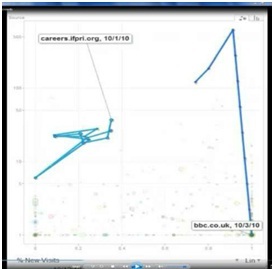
We can measure different user profiles and assess quality of that audience using some of the advanced Google analytics tools. For example we can track user behavior around two sites which bring traffic to IFPRI.ORG, careers.ifpri.org and bbc.co.uk. The graph right shows the differences in new vs returning visitors. As might be expected a careers sites bring a stream of regular visitors who return looking for recent vacancies, while the BBC Newsbring one off visitors who have little ongoing interest in IFPRI but are attracted by the news story on the BBC News site.

Scholarly marketeers

Our researchers serve as marketeers too when they are using scholarly social media resources such as Mendely, Zotero, Google Books.

For the 2020 conference a community on the topic Agriculture Nutrition and Health was built in Mendeley. This community now has 149 members, and each member has its readers followers that gives visibility to other communities we did not know about. The process continues feeding by itself. To achieve this would have required a tremendous effort if it was done by only staff of one organization.

Wikipedia

Special mention needs to be given to Wikipedia as the 'Uber' CrowdMarketeer. We discovered that over 120 wikipedia pages brought traffic to the IFPRI website. Pages in Chinese for IFPRI which we did not know existed were produced by students in Taiwan. The Global Hunger Index Wikipedia page was visited 3000 times in January. We could have not reached that audience with only IFPRI’s website Global Hunger Index page. Particularly now that Wikipedia is embedded in Facebook the combination of the platform and likes leads to an ever increasing audience.

Consequences and effects

As quantitative gains IFPRI and the scholarly marketeer will have more readers, visists, followers, citations, and links.

From the qualitative perspective, the individual marketeer might get e-mail overflow, but gain online presence, prestige and reputation.

Reach

If we look at the effects for one campaign, a combination of classical media with stories on the BBC, in the Guardian and Economist, Le Monde and El Pais together with social media brought the effect below, over 7,000 visits in one day.


How can we differentiate quality from quantity?

Tools such as Google Analytics don’t just allow us to see the impact of campaigns, such as the launch of our own Global Hunger Index leading to three times as much traffic to the website, but also through the motion graph being able to watch the roles of different media outlets in reaching the audience and seeing how this fitted with the role of social media. We could compare stories in the BBC and the Economist with the influence of Facebook and Twitter.

Labels: , , , , ,

04 January 2012

IT, internet and extension

The December 2011 issue of JOE - the Journal of Extension takes a look at information technology and extension.

Content includes:

Extension Is Unpopular—On the Internet

Is Extension Ready to Adopt Technology for Delivering Programs and Reaching New Audiences?

Land-Grant University Employee Perceptions of eXtension: A Baseline Descriptive Study

Leveraging New Media in the Scholarship of Engagement: Opportunities and Incentives

Using Information Technology to Forge Connections in an Extension Service Project

Promoting Healthy Eating and Exercise Through Online Messages: A Pilot Study

Revising an Extension Education Website for Limited Resource Audiences Using Social Marketing Theory

Mapping Extension's Networks: Using Social Network Analysis to Explore Extension's Outreach

An Analysis of the North Carolina Cooperative Extension Service's Role in Bridging the Digital Divide

Social Media Use of Cooperative Extension Family Economics Educators: Online Survey Results and Implications

An Examination of the Strengths, Weaknesses, Opportunities, and Threats Associated with the Adoption of Moodle™ by eXtension

Positive Examples and Lessons Learned from Rural Small Business Adoption of E-Commerce Strategies

Online Nutrition Education: Enhancing Opportunities for Limited-Resource Learners

Social Network Analysis: A Tool to Improve Understanding of Collaborative Management Groups

Virtual Training for Virtual Success: Michigan State University Extension's Virtual Conference

A Successful Multi-Institutional Blog for Transferring Garden and Landscape Information to the Public

Entrepreneurial Extension Conducted via Social Media

Strengthening 4-H Program Communication Through Technology

Working in a Wiki: A Tool for Collaboration Among Virtual Teams

Web-Based Family Life Education: Spotlight on User Experience

An Automated Data Analysis Tool for Livestock Market Data

A State-Specific Online Cover Crop Decision Tool for Midwest Farmers

Labels: , , ,

02 December 2011

Recorded version of IAALD NING Webinar

The webinar presented by Peter Fernandez on December 1 was very well attended with over 20 people participating online and many others inquiring whether they could listen to a recorded version later on. Fortunately, Blackboard Collaborate (formerly Elluminate) allows for the recording and sharing of these webinars and Federico Sancho from IICA has kindly provided the link. IAALD's Executive Committee has decided to make these webinars openly accessible for anyone, however we might want start charging non-members later on.

Click here to listen to the webinar.

A similar seminar in Spanish will be held on December 6, 15:00 GMT-UTC by Miguel Hidalgo, Information Specialist, IICA.

Labels: , , , ,

29 November 2011

Don't miss the IAALD Webinar on NING!


Here is the link for the IAALD Webinar on NING, Thursday, December 1, 16:00 UTC-GMT.

Participants are invited to log in at least 15 minutes prior to the start of the webinar, type their name, download Java 6, define connection speed, and check the audio. Once admitted to the Blackboard Collaborate (previously Elluminate) platform, use the CHAT to send us a short message with your name, institution and country.

Don't miss this opportunity to learn and to better connect with like-minded colleagues!

Presenter: Peter Fernandez, Agricultural Sciences & Natural Resources Librarian, University of Tenessee, Knoxville, Tennessee, USA

Date: Thursday, December 1, 2011

Time: 11:00 AM EST (16:00 UTC-GMT) check your time zone here

System Requirements
Pc-based attendees
Required: Windnows 7, Vista, XP or 2003 Server

MacIntosh-based attendees
Required: Mac OS X 10.4.11 (Tiger) or newer

Labels: , , , ,

16 November 2011

IAALD Webinar: NING to Connect Information Specialists Worldwide


In its continuous effort to connect people to people, IAALD is offering yet another webinar on December 1, entitled "NING to Connect Information Specialists Worldwide".

NING is a customizable social media platform used by IAALD - and many other communities - to facilitate communications among agricultural information specialists and their stakeholders.

Presenter: Peter Fernandez, Agricultural Sciences & Natural Resources Librarian, University of Tenessee, Knoxville, Tennessee, USA

Date: Thursday, December 1, 2011

Time: 11:00 AM EST (16:00 UTC-GMT) check your time zone here

System Requirements
Pc-based attendees
Required: Windnows 7, Vista, XP or 2003 Server

MacIntosh-based attendees
Required: Mac OS X 10.4.11 (Tiger) or newer

Up to now all IAALD webinars have been free for everyone, but in the future non-IAALD members will most likely be asked to pay a small fee for attending.

Labels: , , , , ,

13 October 2011

Connected agriculture: Mobiles help drive efficiency and sustainability in food and agriculture

A new report from Vodacom and Accenture argues that mobile communications can help to meet the challenge of feeding an estimated 9.2 billion people by 2050.

The study identifies 12 specific opportunities that could increase agricultural income by around US$138 billion by 2020. These are:

Improving access to financial services
  • Mobile payment system
  • Micro-insurance system
  • Micro-lending platform
Provision of agricultural information
  • Mobile information platform
  • Farmer helpline
Improving data visibility for supply chain efficiency
  • Smart logistics
  • Traceability and tracking system
  • Mobile management of supplier networks
  • Mobile management of distribution networks
Enhancing access to markets
  • Agricultural trading platform
  • Agricultural tendering platform
  • Agricultural bartering platform

The report aims to stimulate engagement between mobile operators, governments, NGOs and businesses to realise these opportunities and explore others.


Press release

Download full report

Labels: , , , , ,

31 August 2011

New web resources for rangeland management

A new article in the journal Rangelands introduces new web resources for rangeland management around the world including Rangelands West/Global Rangelands, eXtension Rangelands, and the Range Science Information System.

http://www.srmjournals.org/doi/full/10.2111/1551-501X-33.4.55

Labels: , ,

13 August 2011

IAALD Webinar on Mendeley

Video Interview: Luz Marina Alvaré from IFPRI Washington D.C. (one of the CGIAR centers) shares her experiences in using and promoting Mendeley with researchers.


Labels: , , , ,

02 August 2011

Preparing for the XIV IAALD World Congress in 2013 at Cornell University

Video Interview: Jaron Porciello is chairing the Organizing Committee of the XIV IAALD World Congress, to be held at Cornell University in Ithaca, New York, July 25-28, 2013. Mark it on your calendar!

Labels: , , , ,

30 July 2011

Third IAALD Africa Chapter Conference - May 21-23, 2012

Video Interview: Justin Chisenga, President of the IAALD Africa Chapter working at the FAO Regional Office in Ghana invites to the Third IAALD Africa Chapter Conference, taking place from May 21-23, 2012 in Johannesburg, South Africa. The conference theme is e-Agriculture for Improved Livelihoods and Food Security in Africa. More information is available from the web site www.iaald-africa.org. Abstracts should be submitted by September 30, 2011.

Labels: , , , ,

18 July 2011

India launches rice knowledge management portal

On 16 July, the Indian Prime Minister launch a new rice portal. The portal will help stakeholders to get information on all aspects of rice.

The Rice Knowledge Management Portal (RKMP), funded by National Agricultural Innovation Project (NAIP), would use various ICT (information technology and communication) tools to provide info even on mobile phones.

The portal is built on web 2.0 standards and caters to the location specific information needs of many stakeholders throughout India.

There seem to be 2 different versions:

http://www.rkmp.co.in/ or http://rkmp.iari.res.in/.

Labels: , , , , ,

15 July 2011

The CIARD Fair - a new online facility to improve research communication

The latest development of the CIARD (Coherence in Information for Agricultural Research for Development) initiative has been launched on its website – namely the CIARD virtual Fair. For those who are involved in the capture, management and communication of research information and knowledge, the Fair provides a rich environment for discovery, learning and sharing.

The CIARD initiative works to make public domain outputs of agricultural research information and knowledge truly publicly available and accessible to all. The initiative, started in 2008, is led by a group of major international organizations, all with a long-standing role in enhancing the sharing of information and knowledge arising from agricultural research.

The CIARD Fair is an innovative resource that allows visitors to navigate through three routes: the ‘Pathways’ – describing in detail ways to share research outputs more effectively; ‘Services’ – which are standards, tools, systems and training for achieving the Pathways; and ‘Enablers’ - the organizations that provide Services for achieving the Pathways. Visitors can explore the different routes through the Fair according to their specific interests. Each Pathway, Service and Enabler is linked to further more detailed information and shows ways to explore other resources on the Internet. Navigation through the interconnected elements of the Fair is intuitive and is designed to provide an information-rich environment for the visitor.

Organizations can show services and products in the Fair which will be useful to those investigating and learning about the opening up and sharing of research information and knowledge, and there are currently 18 Enablers and 27 Services included in the current Fair. The CIARD partners are eager to develop the Fair by encouraging new enabling organizations and services to get involved.

You can explore the Fair at the CIARD site

Labels: , , , ,

22 June 2011

New book: ICTs for agriculture and rural development

Our colleague Raj Saravanan has co-authored a new book 'Information and Communication Technology for Agriculture and Rural Development' with a wide range of chapters covering the e-agriculture world in India.

Get more information about this book - and his other related publications.

Labels: , , , ,

21 June 2011

IAALD Webinar: Creating Websites on the Fly, June 24

IAALD is continuing with its successful webinars series. The upcoming webinar on June 24, "Decentralizing online publishing in your organization: Creating websites on the fly using Wordpress and Google", will be presented by Peter Shelton from IFPRI (International Food Policy Research Institute).

Please join us for a brief introduction on using Wordpress and Google Sites for project websites, online newsletters, group spaces, event blogs and other innovative applications. We also will discuss policies and practices for creating, launching and managing these sites and show how they can boost your organization's online presence.

These tutorials are designed to showcase web tools and applications and how they are used to support your work and it is our hope that participants will come ready to explore and discuss these topics with their colleagues in further detail.

Presenter: Peter Shelton, International Food Policy Research Institute (IFPRI)

Date: Friday, June 24, 2011

Time: 10:00 AM - 11:00 AM EDT check your time zone here

System Requirements
Pc-based attendees
Required: Windnows 7, Vista, XP or 2003 Server

MacIntosh-based attendees
Required: Mac OS X 10.4.11 (Tiger) or newer

Reserve your Webinar seat now at: https://www3.gotomeeting.com/register/870299622

After registering you will receive a confirmation email containing information about joining the Webinar.

Up to now all IAALD webinars have been free for everyone, but in the future non-IAALD members will most likely be asked to pay a small fee for attending.

Labels: , , , , ,

19 June 2011

Sharing data and information for agricultural research

This week, the Chinese Academy of Agricultural Sciences hosts an International Expert Consultation to build a framework for data and information sharing for agricultural research for development.

The papers for the event are all online - a good first step towards better accessibility. The papers include one prepared by the IAALD past president Barbara Hutchinson.

A large number of papers have been mobilised, including these:

A Framework for Data and Information sharing for ARD - Ajit Maru
Agricultural Information Sharing in the GAINS Experience - Joel Sam
Agricultural Knowledge Sharing in the Philippines - Mila Ramos
Building the CIARD Framework for Data and Information Sharing - Moroccan case - Ottam
Building the CIARD Framework for Data and Information Sharing - Kenya case - Richard Mugata
Building the CIARD Framework for Data and Information sharing - Papua New Guinea case - Seniorl Anzu
CIRAD contribution to scientific dissemination at institutional, national and international level - Marie-Claude Deboin
Co-learning and co-creation within knowledge exchange platform - Myra Wopereis-Pura
Crop Germplasm Resources CGR Information Sharing in China - Fangwei
Expanding Thai Agricultural Boundary of Knowledge - Lessons Learned from Thai AGRIS Centre - Aree Thunkijjanukij
Livestock Research for Rural Development - T. R. Prest
Observations on the aspects of how CABI manages and shares its information - Qiaoqiao Zhang
Persistent identifiers - Comparing schemes for their use in the CIARD Framework - Hugo Besemer
Perspective on Efforts to Share Data and Information in the Central Asia and Caucasus Region - Oleg Shatberashvili
The status of Data and Information Sharing in the Republic of Yemen - Mohamed Noman Sallam
Advanced Resaerch of sharing of basic feed composition data based on China Feed-DataBase Information Center - CFIC - Xiong Benhai
An attempt to integrate huge scientific data with interoperability in Japan - Seishi Ninomiya
Building the CIARD framework for Data and Information Sharing - Mauritius - Krishan Bheenick
CAAS information sharing and Perspectives for the framework development - Pan Shuchun
Communicating Agricultural Science and Technology - Indicators, Lessons Learned - Flaherty
Data Information Sharing in Ministry of Agriculture and Rural Development â?? Vietnam - Nguyen Nghi
Knowledge as a Service for Agriculture Domain - Asanee Kawtrakul
Sharing experience in the Network of Aquaculture Centres in Asia-Pacific - Simon Wilkinson
Holistic AGRO-ICT solutions considering also the integration of horizontal and vertical stakeholders - Walter H. Mayer
IAALDs Commitment to and Promotion of Agricultural Information Sharing and the CIARD Movement - Barbara Hutchinson
The role of the CIARD RING in the Building of the CIARD Framework for Data and Information Sharing - Valeria Pesce
Vision paper - ITPGRFA
Summary paper of the e-consultation - Tom Baker

Labels: , , , , , ,