04 May 2012

CIARD publishes framework for sharing data and information for global agricultural research

CIARD (Coherence in Information for Agricultural Research for Development) is a global movement to enhance access to data and information in the public domain to improve development based on agricultural research results.

In 2011, CIARD partners organized international consultations to understand and analyze the features of data and information sharing problems. The major product was the design of a framework and action plan to improve data and information sharing, and enhanced collaboration, worldwide.

The framework (the 'Beijing Agenda' comprises three dimensions, each with specified 'action areas where CIAR partners can take specific concrete actions':

Technical issues and technologiesAction Area 1 - Services, Tools and Infrastructure
Action Area 2 - Standards and Systems Architecture

Institutional and organizational aspectsAction Area 3 - Policies, Strategies and Institutional Structures
Action Area 4 - Development of Skills and Competencies
Action Area 5 - Appropriate Organizational Structures and Work Practices
Action Area 6 - Global Improvement of Data and Information Flows

Championing change in policy and practice
Action Area 7 - Advocacy and Evidence

Download a 'technical issues paper' in support of the Framework for Sharing Data and Information for Global Agricultural Research is available online.

View a presentation on the 'Beijing Agenda':

Labels: , ,

25 February 2012

CrowdMarketeers - think 'outside our webs' to measure our online audiences

Chris Addison and Luz Marina Alvare (IFPRI) explain ways to 'think beyond the web', beyond our domains, to measure online audiences.

Web statistical tools have made it easy to measure visits, but it provides the wrong idea as to what is important when working out the audiences that we need to be reached. Perhaps, we need to start thinking further than our organizations Domain URL. We need to think 'outside our- web.' Make sure that other Domains contain the research terms we want to reach. Then a new way to measure audiences opens up.

We all have the roughly identical world maps of our visitors from Google. The United States is colored in the heaviest green, then perhaps Europe followed by Asia. Africa probably has the lightest shades of green on the map. But this view just shows overall numbers of visitors, so no surprise that shows the most visitors come from the most connected countries. We get a very different view when we look at what proportion of the internet audience we reach in each country. This isn’t so hard to do, we have figures for how many people are connected to the internet from the International Telecommunications Union and by dividing the number of visits we have by this number we get a proportional value of the reach we have. For IFPRI the picture immediately changes and our greatest reach appears to be in Ethiopia, while the United States suddenly drops to being below the top 60 countries in term of reach. A new view of what is really happening in terms of the proportion of the audience we are reaching is displayed and which countries are worth investigating more.

Where does our audience come from?

The audience doesn’t arrive directly to the front page of your website, they come through intermediaries and different pathways. These sites and services we have called “crowdmarketeers”. The crowdmarketeers market the website to a crowd on our behalf, but often without our knowledge unless we use the analytical tools to identify them and learn more of our users behavior. An organizations visibility, impact and prestige grow based on these marketeers rather than just our own efforts.


Who are the crowdmarketeers

Even though we crowd market our products through email, we have to acknowledge the key role played by academic directories and search engines such as REPEC, Google Scholar, Google Books and sites such as Wikipedia. Twitter, Facebook and scholarly social media services such as Mendeley and Zotero which are based on people networking are particularly powerful crowdmarketeers.

Different products have different staying power

In looking into the measurement of online use, we find that different products behave differently and have different crowd marketeers. Products like the Global Hunger Index are visited all year round, while other publications have a short shelf life.

Where are the conversations happening?

Different marketeers play different roles depending on the topic. The conversations on a particular issue are found in different places. For example hunger is heavily discussed in the blogosphere, but hardly appears in the search engines. Agriculture is a major proportion of Wikipedia, but hardly appears in the LinkedIn community mentioned.

Different CrowdMarketeers for different types of audiences

Different crowd marketeers bring different types of visitors. If you are looking simply at volume then Wikipedia, Feedburner, Email and Google Books prove to be the most important. If you look at how many pages each visitor vists, then websites are more important. The Washington post, Nestle, World Food Program were the top sites by this criteria. They were followed by directories such as REPEC, ELDIS and Google Books which are more likely to appeal to researchers. Somewhere in the middle are the feed and email subscribers using feedburner services to stay in touch with changes to the IFPRI website. Finally if we look at average time on the site we get a different list with email clearly at the front, Google books, ELDIS and SciDev. The mobile site now is growing and showing that visitors are spending more time on the website.

Different CrowdMarketeers reach different audiences around the world.

Email reaches around the world but social media has more impact in the US India and Europe. Wikipedia brings comparatively more users from Germany. Facebook brings visitors to the website from across Africa but particularly Kenya. Feedburner brings a comparatively large audience from Australia, second only to the United States. In Africa, the number of users of Social Media is growing, most specially Facebook and Twitter.

Learning more about the audience


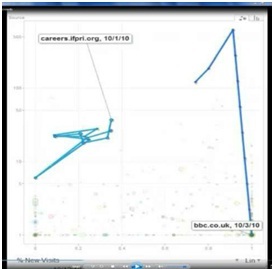
We can measure different user profiles and assess quality of that audience using some of the advanced Google analytics tools. For example we can track user behavior around two sites which bring traffic to IFPRI.ORG, careers.ifpri.org and bbc.co.uk. The graph right shows the differences in new vs returning visitors. As might be expected a careers sites bring a stream of regular visitors who return looking for recent vacancies, while the BBC Newsbring one off visitors who have little ongoing interest in IFPRI but are attracted by the news story on the BBC News site.

Scholarly marketeers

Our researchers serve as marketeers too when they are using scholarly social media resources such as Mendely, Zotero, Google Books.

For the 2020 conference a community on the topic Agriculture Nutrition and Health was built in Mendeley. This community now has 149 members, and each member has its readers followers that gives visibility to other communities we did not know about. The process continues feeding by itself. To achieve this would have required a tremendous effort if it was done by only staff of one organization.

Wikipedia

Special mention needs to be given to Wikipedia as the 'Uber' CrowdMarketeer. We discovered that over 120 wikipedia pages brought traffic to the IFPRI website. Pages in Chinese for IFPRI which we did not know existed were produced by students in Taiwan. The Global Hunger Index Wikipedia page was visited 3000 times in January. We could have not reached that audience with only IFPRI’s website Global Hunger Index page. Particularly now that Wikipedia is embedded in Facebook the combination of the platform and likes leads to an ever increasing audience.

Consequences and effects

As quantitative gains IFPRI and the scholarly marketeer will have more readers, visists, followers, citations, and links.

From the qualitative perspective, the individual marketeer might get e-mail overflow, but gain online presence, prestige and reputation.

Reach

If we look at the effects for one campaign, a combination of classical media with stories on the BBC, in the Guardian and Economist, Le Monde and El Pais together with social media brought the effect below, over 7,000 visits in one day.


How can we differentiate quality from quantity?

Tools such as Google Analytics don’t just allow us to see the impact of campaigns, such as the launch of our own Global Hunger Index leading to three times as much traffic to the website, but also through the motion graph being able to watch the roles of different media outlets in reaching the audience and seeing how this fitted with the role of social media. We could compare stories in the BBC and the Economist with the influence of Facebook and Twitter.

Labels: , , , , ,

15 July 2011

The CIARD Fair - a new online facility to improve research communication

The latest development of the CIARD (Coherence in Information for Agricultural Research for Development) initiative has been launched on its website – namely the CIARD virtual Fair. For those who are involved in the capture, management and communication of research information and knowledge, the Fair provides a rich environment for discovery, learning and sharing.

The CIARD initiative works to make public domain outputs of agricultural research information and knowledge truly publicly available and accessible to all. The initiative, started in 2008, is led by a group of major international organizations, all with a long-standing role in enhancing the sharing of information and knowledge arising from agricultural research.

The CIARD Fair is an innovative resource that allows visitors to navigate through three routes: the ‘Pathways’ – describing in detail ways to share research outputs more effectively; ‘Services’ – which are standards, tools, systems and training for achieving the Pathways; and ‘Enablers’ - the organizations that provide Services for achieving the Pathways. Visitors can explore the different routes through the Fair according to their specific interests. Each Pathway, Service and Enabler is linked to further more detailed information and shows ways to explore other resources on the Internet. Navigation through the interconnected elements of the Fair is intuitive and is designed to provide an information-rich environment for the visitor.

Organizations can show services and products in the Fair which will be useful to those investigating and learning about the opening up and sharing of research information and knowledge, and there are currently 18 Enablers and 27 Services included in the current Fair. The CIARD partners are eager to develop the Fair by encouraging new enabling organizations and services to get involved.

You can explore the Fair at the CIARD site

Labels: , , , ,

14 July 2011

Le salon virtuel CIARD : des pratiques et des services innovants pour partager l’information et les connaissances

L’initiative CIARD vient de mettre en ligne un salon virtuel, http://www.ciard.net.

Vous y trouverez des itinéraires de découverte, d’apprentissage et d’échange des connaissances issues de la recherche agricole pour le développement.

L’initiative CIARD a pour objectif de render accessible à tous les informations et les connaissances issues de la recherche agricole. L’initiative qui a été initiée en 2008, est menée par de nombreuses organisations internationales qui ont la vocation le partage des connaissances des savoirs et des savoirs-faire.

Trois parcours sont possibles:
1. les « itinéraires » proposent des méthodes pour partager les résultats de recherche ;
2. les « services » décrivent les normes, les outils, les infrastructures et les supports de formation nécessaires pour diffuser l’information ;
3. les « facilitateurs » présentent les organisations qui fournissent les services associés aux itinéraires.

Les services et produits sont destinés à ceux qui veulent en savoir plus ou qui souhaitent se former à la diffusion et au partage des connaissances issues de la recherche.
Les visiteurs peuvent explorer les parcours selon leurs domaines d’intérêt. Chaque itinéraire, service et facilitateur oriente le visiteur vers des sites d’information détaillés. La navigation est intuitive et offre un environnement riche et varié.

A ce jour, 18 acteurs exposent 27 services. Toutes les institutions sont invitées à y participer.

Labels: , , ,

13 July 2011

La feria CIARD : un nuevo servicio en línea para mejorar la comunicación de la investigación

El último desarrollo de la iniciativa CIARD (Coherencia en la información para la investigación agrícola para el desarrollo), ha lanzado la feria virtual CIARD en su sitio web. Para aquellos que involucrados en la captura, gestión y comunicación de la información y el conocimiento en investigación, la feria ofrece un ambiente abundante para el descubrimiento, el aprendizaje y el intercambio.

La iniciativa CIARD trabaja para hacer que los resultados de dominio público del conocimiento y la información sobre investigación agrícola, realmente estén a disposición del público y accesible para todos. La iniciativa, que comenzó en 2008, está dirigido por un grupo de importantes organizaciones internacionales que cuentan con una larga trayectoria en mejorar el intercambio de información y conocimientos derivados de la investigación agraria.

La feria CIARD es un recurso innovador que permite a los visitantes navegar a través de tres rutas: "las rutas" - que describe en detalle los modos de compartir resultados de investigación más eficaz, "los servicios" - que son los estándares, herramientas, sistemas y capacitación para el logro de las rutas; y "los agentes" - las organizaciones que prestan servicios para el logro de las rutas. Los visitantes pueden explorar las diferentes rutas a través de la Feria de acuerdo a sus intereses específicos. Cada ruta, servicio y agente están vinculados a información más detallada y muestra maneras de explorar otros recursos en Internet. La navegación por los elementos interconectados de la feria es intuitivo y está diseñado para proporcionar un ambiente abundante de información para el visitante.

Las organizaciones pueden mostrar en la feria, sus servicios y productos que sean de utilidad para quienes investigan y desean aprender sobre la apertura y el intercambio de información y conocimiento de la investigación. Actualmente la feria dispone de 18 agentes y 25 servicios. Los socios de CIARD están dispuestos a desarrollar la feria, promoviendo la participación de nuevas organizaciones que deseen participar como agentes y mostrar sus servicios.

Explore la feria CIARD

Labels: , , ,

Research4Life - journal access for low and middle income countries

Research4Life is a public-private partnership whereby 150 publishers provide free or very low-cost access to the full text of over 8000 journals in low and middle income countries. This partnership is now celebrating its 10th Anniversary and partners are meeting in London to discuss the next steps.

Labels: , ,

19 June 2011

Sharing data and information for agricultural research

This week, the Chinese Academy of Agricultural Sciences hosts an International Expert Consultation to build a framework for data and information sharing for agricultural research for development.

The papers for the event are all online - a good first step towards better accessibility. The papers include one prepared by the IAALD past president Barbara Hutchinson.

A large number of papers have been mobilised, including these:

A Framework for Data and Information sharing for ARD - Ajit Maru
Agricultural Information Sharing in the GAINS Experience - Joel Sam
Agricultural Knowledge Sharing in the Philippines - Mila Ramos
Building the CIARD Framework for Data and Information Sharing - Moroccan case - Ottam
Building the CIARD Framework for Data and Information Sharing - Kenya case - Richard Mugata
Building the CIARD Framework for Data and Information sharing - Papua New Guinea case - Seniorl Anzu
CIRAD contribution to scientific dissemination at institutional, national and international level - Marie-Claude Deboin
Co-learning and co-creation within knowledge exchange platform - Myra Wopereis-Pura
Crop Germplasm Resources CGR Information Sharing in China - Fangwei
Expanding Thai Agricultural Boundary of Knowledge - Lessons Learned from Thai AGRIS Centre - Aree Thunkijjanukij
Livestock Research for Rural Development - T. R. Prest
Observations on the aspects of how CABI manages and shares its information - Qiaoqiao Zhang
Persistent identifiers - Comparing schemes for their use in the CIARD Framework - Hugo Besemer
Perspective on Efforts to Share Data and Information in the Central Asia and Caucasus Region - Oleg Shatberashvili
The status of Data and Information Sharing in the Republic of Yemen - Mohamed Noman Sallam
Advanced Resaerch of sharing of basic feed composition data based on China Feed-DataBase Information Center - CFIC - Xiong Benhai
An attempt to integrate huge scientific data with interoperability in Japan - Seishi Ninomiya
Building the CIARD framework for Data and Information Sharing - Mauritius - Krishan Bheenick
CAAS information sharing and Perspectives for the framework development - Pan Shuchun
Communicating Agricultural Science and Technology - Indicators, Lessons Learned - Flaherty
Data Information Sharing in Ministry of Agriculture and Rural Development â?? Vietnam - Nguyen Nghi
Knowledge as a Service for Agriculture Domain - Asanee Kawtrakul
Sharing experience in the Network of Aquaculture Centres in Asia-Pacific - Simon Wilkinson
Holistic AGRO-ICT solutions considering also the integration of horizontal and vertical stakeholders - Walter H. Mayer
IAALDs Commitment to and Promotion of Agricultural Information Sharing and the CIARD Movement - Barbara Hutchinson
The role of the CIARD RING in the Building of the CIARD Framework for Data and Information Sharing - Valeria Pesce
Vision paper - ITPGRFA
Summary paper of the e-consultation - Tom Baker

Labels: , , , , , ,

23 May 2011

Sus investigaciones son comunicadas efectivamente? Comparta su opinión

Un gran desafío que enfrentan los investigadores actualmente es cómo comunicar sus resultados de investigación de manera más efectiva.

El CGIAR (Grupo Consultivo Internacional para la Investigación Agrícola), la FAO (Organización de las Naciones Unidas para la Agricultura y la Alimentación) y el GFAR (Foro Mundial para la Investigación Agraria) están llevando a cabo un estudio global para reunir evidencia de los investigadores sobre los beneficios potenciales y preocupaciones de una comunicación más amplia de los resultados de sus investigaciones, y promover vías innovadoras para que puedan compartir mejor sus resultados.

Esta breve encuesta está destinada a investigadores y científicos que trabajan en el ámbito de la agricultura, ganadería, silvicultura, pesca, alimentación y nutrición, y otras que estén vinculadas con las anteriores en ámbitos como biología, medio ambiente, economía y disciplinas sociales. Su participación en ésta encuesta es sumamente valiosa, e instamos a compartir nuestra invitación con otros colegas y pares en los ámbitos mencionados.

Comparta su opinión en este breve cuestionario : http://surveymonkey.com/s/ciard-investigador

Esta encuesta es parte de un estudio sobre CIARD (coherencia en la información agrícola para la investigación para el desarrollo).

Labels: , , , , ,

Les résultats de vos recherches sont-ils communiqués efficacement? Donnez-nous votre avis!

Un des plus grands défis pour les chercheurs aujourd'hui est de communiquer les résultats de leurs recherches plus efficacement.

Le GCRAI (Groupe consultatif pour la recherche agricole internationale), la FAO (Organisation des Nations Unies pour l'alimentation et l'agriculture) et le GFAR (Forum mondial de la recherche agricole) réalisent une enquête auprès des chercheurs du monde entier sur les avantages et inconvénients potentiels liés à une communication de leurs résultats à plus grande échelle, afin de promouvoir des moyens innovants pour un meilleur partage de ces données.

Cette enquête s’adresse aux chercheurs spécialisés dans l’agriculture, l’élevage, les forêts, la pêche, l’alimentation et la nutrition, et les domaines biologiques, environnementaux, économiques et sociaux apparentés. Votre participation serait très appréciée, et nous vous encourageons à faire suivre cette invitation à vos collègues et pairs qui travaillent dans les disciplines concernées.

Faites-nous connaître votre avis en participant à cette courte enquête: http://surveymonkey.com/s/ciard-chercheur

Cette enquête s’inscrit dans le cadre d’une étude de CIARD (Cohérence de l'information sur la recherche agricole pour le développement).

Labels: , , , , , ,

Is your research being communicated effectively? Share your views

A major challenge faced by researchers today is how to communicate their research outputs more effectively.

The CGIAR (Consultative Group on International Agricultural Research), FAO (Food and Agriculture Organisation of the United Nations) and GFAR (Global Forum on Agricultural Research) are conducting a global survey to gather evidence from researchers on potential gain and concerns of a wider communication of research results, and promote innovative pathways for better sharing their outputs.

This survey is intended for researchers working in agriculture, livestock, forestry, fisheries, food and nutrition, and related biological, environmental, economic and social fields. Your participation in this survey is very valuable, and we also want to encourage you to extend this invitation to other colleagues and peers working on the disciplines mentioned.

Share your views by taking a short survey: http://surveymonkey.com/s/ciard-researcher

This survey is part of a study on CIARD (Coherence in Information for Agricultural Research in Development).

Labels: , , , , ,

17 April 2011

Using Mendeley: First IAALD webinar great success

On Friday, April 8th, Luz Marina Alvare (IFPRI) conducted a webinar on Mendeley on behalf of IAALD.

With a combination of PPT slides and live examples, Luz Marina provided more than 30 participants with an excellent introduction to Mendeley and how it can be used practically for research management on desktops and the web.

Mendeley provides powerful but easy to use capabilities to catalog, share, import, and manage academic papers. The software is free and facilitates collaborative research.

See the webinar presentation below; we plan to make the recorded session available, as well as the Spanish version of the PPT slides.

Labels: , , , , ,

11 February 2011

CIAT's new Capacity Strengthening and Knowledge Management Initiative


News from Simone Staiger at CIAT:

I am writing to you to share with you the launch of CIAT’s Capacity Strengthening and Knowledge Management Initiative. The focus of the Initiative will be on four areas:

1. Facilitate and cultivate knowledge exchange through a Regional Training Initiative for Latin America and the Caribbean
2. Support the CIAT-Corpoica-Colombian Ministry of Agriculture initiative for Climate Change and the Ornioquía through interventions in capacity building and knowledge management
3. Carry out research on knowledge management and promoting organizational change
4. Strengthen training activities in CIAT

Read more at: http://ciatcapacity.cgiar.org/en

Labels: , , , ,

07 February 2011

Integrated approaches to development action through communication strategies

A side event at this weeks IFPRI conference 'Leveraging Agriculture for Improving Nutrition and Health' looks at ways that "communications can help bring agriculture, nutrition, and health closer together."

Download the background paper by Warren Feek who argues:

"When looking at the question of leveraging agriculture for improved nutrition and health from a communication perspective, it is vitally important to clarify where the main challenges lie. The problem is not at the community level; the issue is how international development action is organized overall.

Development efforts can benefit greatly from 1) prioritizing a set of communication processes that ensures that the voices, ideas, perspectives, and plain common sense of people in local communities are included and amplified, and 2) promoting effective communication among development stakeholders in order to enhance coordination and cooperation across different vested interests and issues.

Action based on these two processes will generate the greatest outcomes; through effective communication, the efforts and energies of development agencies and local populations will result in accelerated action that breaks down unhelpful divisions, including those among agriculture, nutrition, and health."

Labels: , , , , ,

26 November 2010

Do ICTs enhance rural livelihoods?: Research findings from a study in Asia

IDRC with IFAD–ENRAP have been researching and generating evidence for the influence or change-making potential of ICTs on rural livelihoods in Asia - in a rigorous way.

Seven research proposals – a combination of action-research pilots and ex-post evaluations - were supported (one is still on-going) over 2009-2010 after an initial scoping study and subsequent consultation with a set of researchers and practitioners. While six research pieces look at farmers and farmer livelihoods, one also looks at improving access to jobs for rural casual wage labor by better matching of skills and job requirements.

Six of the seven research studies have recently reached an important milestone. Researchers have put together their findings. And even though in case of action research pilots, the research is ongoing, they have some interesting results to share. Briefs on each of the research studies and full papers are available at: http://www.enrap.org/research/icts-for-livelihoods-research/icts-for-livelihoods-research-papers/.

The papers include:

Connecting to Work: Non-agricultural livelihood opportunities for Rural Labour: Sri Lanka (wage labour)

Livelihood Solutions through Mobile Technology: An Assessment of LifeLines in India by IRRAD

Crop Nutrient Management Decision Support System: India

Impact Assessment of the e-AGRIKultura Project: Philippines

Evaluation of Rural Information Project for the Promotion of Agricultural Livelihood in Rural Community in Ningxia of China by AII

Price Transparency in Agricultural Produce Markets: Sri Lanka

Beyond Technology: Making Information Work for Livelihoods

Beyond Projects: Making Sense of the Evidence

Labels: , , , , , , ,

08 November 2010

Researchers and farmers in Burkina Faso benefit from AGORA

A recent video illustrates how INERA (Institut de l'Environnement et de Recherches Agricoles), Burkina Faso's leading institute for agricultural and environmental research, is using the Access to Global Online Research in Agriculture (AGORA) programme to access online scientific research journals with information on fertilizers and dosages, including a focus on maximizing production.

View the video / download the press release (PDF)

Labels: , , , , , , , ,

10 August 2010

The Role of Libraries in Supporting Agricultural Policy Research in Nigeria

This short brief summarizes results from an IFPRI assessment of the capacity of Nigerian libraries within the National Agriculture Research System (NARS) to support agricultural policy research.

The main conclusions:

To support a transition to 'virtual libraries', the university libraries in Nigeria "need to develop appropriate infrastructure, strengthen their staff capacity, build consortia, and strengthen communications."

Infrastructure: The main impediments to Nigeria’s university library system are inadequate power and Internet bandwidth.

Capacity: It is evident that the staffing needs for supporting library users have not been met

Consortia: Efforts are needed to strengthen the few existing library consortia — or to develop a new consortium supporting agriculture research

Communication: The communication gap between library staff and faculty and students results in the underuse of library resources.

Labels: , , , , , , ,

09 July 2010

Social media for research communication: Opportunities and threats

From 5-7 July 2010, ILRI and IKM Emergent hosted a learning and exchange workshop in Nairobi on research communication. Participants came from research and development organizations in East and Southern Africa. The wiki from the workshop shows the work of the participants.

The end session included a review by participants of the opportunities and threats provided and posed by social media for research communicators:

The opportunities:
  • we can better manage our e-resources
  • social media add interactivity to our work (it helps 'spread our wings')
  • social media facilitate easy, cheap, speedy finding, sharing and connecting of credible information
  • with social media, we can reac new audiences in real time
  • social media increase the visibility of us and our institutions
  • with social media, it is easier to identify research gaps

The threats:
  • lack of control over social media could lead to over-exposure and abuse of our products
  • we could lose our privacy
  • do they lead to unsocial behaviour, with an over-reliance on personal virtual connections over inter-personal ones.
  • there are threats to the ownership of our work
  • Will ICT-challenged individuals ever buy in to these approaches?
  • social media requires some creativity ... which may be off-putting to people who do not think they are creative
  • limited or low bandwidth holds back social media use
  • social media may be perceived to be time wasting

We also asked participants to identify some next steps they might take resulting from the workshop. Responses included:
  • training colleagues
  • moving from baby steps to giant leaps ...
  • 'BEING' social, there is no other option
  • applying the tools in my own work ...
  • changing the way we approach research work

Labels: , , , , ,

08 July 2010

Open access: Maximising research impact

Find out more about this workshop organized by Bioversity Inetrnational and CAS-IP. Presentations, background materials ... all available for all.

More articles on open access ...

Labels: , , , , ,

14 May 2010

Una nueva plataforma para promover el acceso a las ciencias agrarias : lanzamiento del nuevo sitio web de CIARD

El nuevo sitio web de la iniciativa global Coherencia en la información para la investigación agraria para el desarrollo (CIARD) fue lanzado por sus principales socios durante el XIII Congreso Mundial de IAALD en Montpellier.

CIARD es un movimiento que busca la coherencia y colaboración en la información y comunicación de la investigación agraria y reúne a instituciones y personas que desean hacer que los productos de la investigación agraria de dominio público sean verdaderamente accesibles a todos. El Manifiesto de CIARD y otras herramientas proporcionan un marco de políticas y prácticas para que quienes poseen y producen información y conocimientos puedan compartir sus productos mundialmente y de modo más eficaz.

El sitio web ofrece una plataforma virtual para la participación de instituciones en las actividades de CIARD, para que evalúen sus prácticas de gestión de información en función de una Lista de verificación de buenas prácticas, compartan y cumplan con las Vías focalizadas de acceso a objeto de mejorar la accesibilidad de la información y contribuyan con estudios de caso, y permite registrar sus servicios de información en el CIARD RING.

La iniciativa CIARD acaparó la atención en el Congreso IAALD y sirvió de eje central de la "Feria de Acceso a la Información" dirigida a aquellos participantes interesados en hacer que los productos de la investigación de sus instituciones sean verdaderamente accesibles, en base a un conjunto de valores comunes. El nuevo sitio web de CIARD está disponible en tres idiomas y es coordinado por la Organización de las Naciones Unidas para la Agricultura y la Alimentación (FAO) y el Foro Global de Investigación Agropecuaria (GFAR).

Para más información sobre CIARD, visite el sitio web: www.ciard.net, y sobre el Congreso: http://iaald2010.agropolis.fr/

Labels: , , , , ,

13 May 2010

CIARD website a new platform to promote access to agricultural science

At the XIIIth World Congress of IAALD held in Montpellier, the new website of the global initiative on Coherence in Information for Agricultural Research for Development (CIARD)was launched by the principal partners. CIARD is a movement for coherence and collaboration in agricultural research information and communication that brings together institutions and people who want to make agricultural research outputs in the public domain truly accessible to all.

The CIARD Manifesto www.ciard.net/ciard-manifesto and other tools provide a framework of policy and practices for those holding and creating information and knowledge to share their outputs globally and more efficiently.

The web site provides a virtual platform for institutions to participate in CIARD activities, evaluate their information management practices against a Checklist of good practices, share and follow Pathways towards better accessibility of information, and contribute case studies. It also registers their information services in the CIARD RING.

The CIARD initiative provided a major attraction at the IAALD Congress, also acting as the central anchor for the "Information Access Marketplace" aimed at engaging participants interested in making their institutions' research outputs truly accessible, based on a common set of values. The new CIARD website is in three languages and is coordinated by the Food and Agriculture Organization of the United Nations (FAO) and the Global Forum for Agricultural Research (GFAR).

For more information on CIARD, please visit: www.ciard.net.

For the Congress visit: http://iaald2010.agropolis.fr.

Labels: , , , , ,