19 October 2008

Mobile telephony and public-private partnerships keys to agricultural development

On the e-agriculture.org web site, a report from the e-Agriculture panel at the recent IAALD-AFITA-WCCA World Congress.

“How can we make agricultural information and information technology truly accessible?” This question was put forward by Peter Ballantyne, IAALD President, on the first day of the IAALD-AFITA-WCCA World Conference 2008.

On the final day of the conference, the challenge was taken up by an e-Agriculture participatory panel discussion facilitated by FAO focusing on multi-stakeholder partnerships and the roles of mobile phones in support of agricultural development.

There was a lively debate focusing on issues of ICT as enablers in various critical areas of development, as well as the role of Public Private Partnerships (PPP) in support of e-Agriculture.

Read the e-agriculture.org news item / download the full report of the discussion (pdf)

Labels: , , , , , , , ,

28 August 2008

Only connect? Listening to farmers is key factor for success

The "Only connect?" session at the 2008 IAALD conference in Atsugi, Japan provided the opportunity to hear firsthand from those working with ICTs with farmers in rural areas in Africa, the Caribbean and the Pacific.

The ICT environment has changed significantly in the last year. Low cost laptops have developed following the OLPC (One Laptop per Child) project. Mobile phones are falling in price and offer laptop features. Hosting on the web is often free and an increasing number of web2.0 applications provide a wide range of free or low cost services. Wifi and affordable satellite connection are enabling better and wider connectivity. Moreover, a myriad of applications combine and blend different technologies and also provide access in remote locations.

Together with these technical changes, the policy environment is also evolving, as governments see the value of being connected and being in communication with their rural populations; business sees the value in engaging with rural communities as markets for telecommunications products; users are more aware of the opportunities of technologies and are ready to make the best out of them, as African mobile phone use demonstrates, showing the greatest growth of any market in the world.

In the different examples discussed in the session, there were similar elements in the approaches.

The Connect Africa project, recognizing that power is the key constraint to ICT use, has been using a zinc air fuel cell which provides a locally produced opportunity to produce cells which can power mobile equipment. This way, they provide a public payphone, which supports SMS services and allows farmers to use the systems as they wish, but through an operator, who provides a feedback service. The demand for the phone illustrates that there may be a market for cellular operators, convincing them to extend connection and offer cheaper access than the satellite. Sustainability can be ensured by marketing services to government and business on the back of the payphone service.

An example from the Caribbean showed the use of voice over internet phones. Having experimented using Skype with a PC, the project managers realized a plug in internet phone was easier to introduce. The project negotiated special costs for farmers providing subscriptions at $5/month including free SMS and lobbied to allow VOIP use.

The Pacific has special circumstances in relation to the use of ICTs for agricultural information, where infrastructure, resourcing and geographical isolation have led to the emergence of Radio, TV and satellite transmissions as the main communication platforms. Using Internet over HF radio and exchanging video and audio on tape have been the interventions used for farmers to access information. Experience has shown that in such projects, it is essential to support capacity building, disseminate information based on needs and to undertake information analysis including social and cultural concerns.

Across the seven presentations during the whole session, constraints, approaches, benefits and drawbacks of ICT adoption in rural communities where also discussed at length.

Constraints included a lack of information infrastructure, access and costs, and a clear need for content; in same cases, knowledge sharing may be limited by culture, language and literacy.

Successful approaches began with people, not with technology: “listen to the farmer” was a common call, as only true participation can lead to collective ownership and management. In several cases, public private partnerships have reduced costs and the need to lobby for policy change was emphasized by many of the speakers.

Drawbacks of ICT introduction still include costs, change in social structures and an increased demand on governments and on individuals from their extended families.

Finally the benefits for farmers providing access to markets, farming knowledge, access to resources. Efficiency benefits come with improved communication, saving unnecessary trips and economic benefits for a country can be substantial.

by Chris Addison

See presentations from the session / See video interviews with session speakers and resource persons.

Labels: , , , ,

27 August 2008

Web 2.0 and agricultural research information systems

On 25 August, many participants at the World Conference on Agricultural Information and IT joined the IAALD-organised session on information and agricultural research.

Web 2.0 was a thread in several of the presentations:
Chris Addison introduced R4D (www.research4development.info) – the development research dissemination service of the UK Department for International Development (DFID) and how it is evolving “from a portal to a service.” In the new service, various web 2.0 tools are used to optimized research content so it can travel and be subscribed to. His 5 take away messages:
    1. turn websites into services;
    2. use web2 as a ‘high street’ where the various shops help promote content;
    3. ensure that content is featured on other sites and services;
    4. check how the content is used, and become a user of your own service;
    5. retain a focus on traditional face to face and other dissemination formats.
See Gauri Salokhe’s blog post; View his presentation.

Luz Marina Alvare of IFPRI continued the web 2.0 focus, elaborating on the practical “struggle that organizations like ours go through” to make research information more accessible

From her base in IFPRI’s Library and KM Unit, she is moving the library service in new directions: where research outputs are tagged and made globally accessible, and where “our stuff” is made available in places (on and off the web) where others go. The goal is for IFPRI messages to be in the right places at the right times.

Luz Marina elaborates on the generation effects on information using behaviour:


Takanori Hayashi from Japan’s Agriculture, Forestry and Fisheries Information Technology Center explained how they have started to share research information using RSS feeds.

He explained how the library services are shifting from “waiting for users to access” to a more “offensive” – or proactive – approach. Hayashi sees RSS as an ‘offensive’ user service that pushes information direct to user desktops. The online library catalogue is becoming an “xml data providing system” where information is made available “anywhere, anytime, anyway.”

Finally, Valerie Pesce from the Global Forum on Agricultural Research introduced an ‘ARD Web ring’ – a "voluntary coalition of web spaces that share information related to agricultural research and innovation for development."

See more information from the Japan 2008 Congress

Labels: , , , ,

26 August 2008

Who's who at the Japan Congress

During the past days, we have been taking photos of the congress participants.

We mapped the photos in Flickr. As would be expected for a world congress, they came from all over the world:

Labels: ,

25 August 2008

Tracking the Japan congress through Twitter!

Two colleagues from FAO, Michael Riggs and Gauri Salokhe, are using Twitter to report and reflect on what they hear and who they meet.

Labels: , , , ,

Japan congress opens in Atsugi

Atsugi, Japan, 25 August 2008. This morning, the World Conference on Agricultural Information and IT was officially opened.

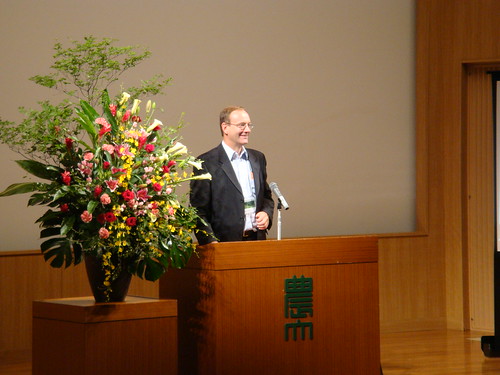
IAALD President Peter Ballantyne welcomed participants, warmly welcoming them to this 12th World Congress of IAALD.

At the end of his remars, see below, he posed participants an ‘Atsugi Question’: “How can we make agricultural information and IT truly accessible?” - asking people to reflect on this and share their thoughts during the congress.

text of the remarks by Peter Ballantyne:

"The first IAALD world congress was held in 1955 in Belgium. Since then, IAALD has held world congresses in Germany, the USA, France, Mexico, the Philippines, Canada, Hungary, Australia, Senegal, and the USA. In 2010, we will return to France.

This is the first time that IAALD has come all the way to Japan; it is also the first time that we joined up with our colleagues from INFITA to hold a world congress on agricultural information and IT.

As our good friend Takashi Nagatsuka from JAALD has said, this joint congress is a step forward for the information management and information technology communities – IAALD with AFITA; JAALD with JSAI, together we can combine our efforts, pool our resources, and fuse together our different and complementary expertise. Let us use this chance to cross-fertilize across and among the many types of information and communication professionals here represented. I urge us all to seek out and make contact with our neighbours!

This is a very opportune moment for us to meet: AFITA, IAALD, INFITA, JAALD, JSAI, NARO, Tokyo University of Agriculture, and the World Congress on Computers in Agriculture – This group of 8, this G8, is a chance for us to take up some of the challenges recently identified by another group of 8 who met in Hokkaido in July.

Their ‘Statement on Global Food Security’, among other things calls for actions to:

“promote agricultural research and development, and the training of a new generation of scientists and experts ... focusing on the dissemination of improved, locally adapted and sustainable farming technologies”

It also calls for actions to

“accelerate research and development and increase access to new agricultural technologies to boost agricultural production”

For me, these keywords – dissemination and access – of technologies, knowledge, and information, are at the core of this congress.

I wish express the appreciation of IAALD to some people present in this room.

Let me start with the closest to us – the Tokyo University of Agriculture. We very much enjoy these marvelous facilities; we very much appreciate the strong support provided by the University to our congress; we recognize the important role of the University in promoting agricultural information in Japan. Thank You.

I am sure that very few of us visiting Japan from abroad have previously visited this city of Atsugi. I have found this to be a friendly city, an eco-friendly city, a visitor-friendly city. It also seems to be an information- and an agriculture-friendly city where we can feel at home and relaxed, and stimulated to share and learn with our colleagues, and indeed with the people in this city. Thank You.

I would like to express our great appreciation to our colleagues working in agricultural information here in Japan – especially the members of JAALD and JSAI. It was truly impressive to see the hard effort and dedication of the many people who worked through the weekend to get this congress ready for us today. And of course, the work has been going on a lot longer than just this weekend. An international meeting like this requires dedicated individuals and organizations, on the ground, to make a success. I am sure this week will be such as a success! Thank you!

However, the most important asset in this room is you, us, the participants. Thank you for investing your time and energy to get here; let us work hard, let us be accessible with each other, openly sharing and disseminating our knowledge. Let us also enjoy ourselves in this wonderful country!

Finally, before I close, I want to pose us all a question. I want to pose us all an ‘Atsugi Question’: “How can we make agricultural information and IT truly accessible?”

I have asked some colleagues to circulate among us this week, asking you for your answers! Let’s see what new and interesting ideas we can generate here in Atsugi!

Labels: , , ,

23 August 2008

Japan congress kicks off

Atsugi, Japan, 24 August: Participants from around the world have started arriving in the small city of Atsugi, south of Tokyo for the 12th IAALD World Congress. Co-sponsored by AFITA, local organizers from JAALD and JSAI have been busy with last minute arrangements at the conference venue, the Tokyo University of Agriculture.

Today started with several pre-congress workshops:
  • Adoption of ICT Enabled Information Systems for Agricultural Development
  • Image Management: Finding and Using Images on the Web
  • Designing Food Management and Security System
  • Geo-ICT and Sensor Network Technology and Applications
In an effort to make some of the congress discussions more accessible to the wider community, this blog, and other web spaces, will carry regular news and updates from the congress. Look across the Internet for the ‘aginfo8’ tag!

Peter Ballantyne welcomes you:


Other places to keep updated on the congress:
We welcome your comments and contributions any of the stories...

Labels: , , ,

19 August 2008

e-Agriculture at the IAALD-AFITA-WCCA World Conference

On 27 August, FAO facilitates an e-Agriculture panel at the IAALD-AFITA-WCCA World Congress. The panel will deliberate issues of ICT as enablers in various critical areas of development, as well as the role of Public Private Partnerships (PPP) in support of e-Agriculture.

The session will be an interactive discussion with the audience, with the panel anchored by:
  • Alexander Flor, Dean, Faculty of Information and Communication Studies, University of the Philippines Open University;
  • Manish Pandey, Deputy Director, Katalyst-Swisscontact;
  • Michael Riggs, Information Management Specialist, FAO Regional Office for Asia-Pacific;
  • Roxanna Samii, International Fund for Agricultural Development (IFAD);
  • and Stephen Rudgard, FAO, as the moderator.
The panelists will share knowledge and experiences, and the audience encouraged to contribute on topics such as the use of mobile telephony use in rural areas, with particular reference to ameliorate global soaring food prices, and knowledge brokering services in support of agricultural development, including Communities of Practice and approaches to building capacity.

There will also be a reprise of the issues arising in this year’s PPP online forum and eIndia conference discussion session entitled "Making e-Agriculture Work through Public Private Partnership in Asia". Experience and lessons in Bangladesh (Katalyst) and West Africa (Tradenet) will be contributed.

Full details of the PPP online forum, and reviews of the two sessions organized by FAO, the Global Knowledge Partnership (GKP), OneWorld South Asia and Katalyst in the e-Agriculture track of India's largest ICT Event, eIndia 2008 in July 2008, can be found on www.e-agriculture.org

Labels: , , , , , ,

11 August 2008

Only connect? Emerging ICT options and opportunities for farmers

On 26 August, CTA will organise a special session at the upcoming IAALD/AFITA World Congress in Japan.

As a result of geographical isolation, poor communication facilities and limited purchasing power, many people working in agricultural development in ACP countries are unaware of the opportunities and resources that are potentially available to support agricultural development in ACP countries.

This is particularly true in the fast moving field of ICTs which is heavily impacting on agriculture and shows great promise for ACP states. In recent years, for instance, technological advances coupled with falling prices in hardware have led to the appearance and increasing availability of low cost mobile computers (such as the XO “$ 100” laptop from OLPC), affordable wireless connectivity together with dozens of free or very low-cost interactive web applications that greatly facilitate the processes of creating, sharing and publishing information, while at the same time profoundly changing the dynamics of collaboration and resource sharing.

An emerging interest at CTA, the “one laptop per farmer” agenda (OLPF) discussed recently at a WSIS related meeting and in recent weblog articles recognises that the host of technological and infrastructural developments is creating an environment in which devices like the XO laptop (and mobile devices such as increasingly ubiquitous mobile phones and PDA’s) can flourish. OLPC and allied technologies could therefore bring huge benefits to ACP farmers coupled with the huge opportunities for outreach for development organisations such as CTA.

This session aims to create a heightened awareness and stimulate discussion on the OLPF agenda, so as to develop concrete potential action lines in this area by CTA and its partners.

The session will combine insights and perspectives from around the world; the organisers invite comments and suggestions on the issues to be discussed and any related resources that should be considered. During the congress (24-27 August), we will publish blog reports and video interviews from this and other sessions.

Labels: , , , , , , , , , ,

07 May 2007

IAALD World Congress 2008

From 24 to 27 August 2008, IAALD will co-organize the World Conference on Agricultural Information and IT. Co-sponsored with AFITA and WCCA, the congress theme is 'advancing information and communication management, knowledge creation and sharing, and the application of information technologies in agriculture.' Register


View Larger Map

This 12th World Congress of the International Association of Agricultural Information Specialists, the 6th World Congress on Computers in Agriculture, and 6th Asian Conference of IT in Agriculture will he held at the Atsagi Campus of the Tokyo University of Agriculture. The local organization is led by the Japanese Society of Agricultural Informatics and the Japanese Association of Agricultural Information Specialists.

According to the World Bank, agricultural development depends to a great extent on how successfully knowledge is generated and applied. Noting the exponential growth in information and communication technologies, especially the Internet, it suggests that knowing how to take advantage of new knowledge has become just as urgent as knowing how to generate and diffuse new knowledge.

While advancements in information and communication management, knowledge creation and sharing, and information technologies indeed offer many opportunities to work differently and more effectively, the broad agricultural information community faces significant challenges.

In particular, information and knowledge workers need to address shifts in agricultural production, trade and innovations systems as well as evolving concerns for sustainable rural livelihoods, the conservation of the environment, protection of rural lifestyles and landscapes, and urgent challenges linked with climate change and the search for renewable energy sources.

This Conference brings together researchers, communicators, knowledge managers, IT experts and information specialists to share and discuss the application and uses of information, knowledge and IT in agriculture. These include new applications of well established and understood technologies, innovative and entrepreneurial applications of emerging technologies, as well as issues related to policy and knowledge dissemination.

The Conference provides a precious chance for participants from all over the world to meet and share knowledge on all aspects of ag-bioscience information and agro-informatics development. Participants will be from diverse backgrounds, including practitioners, researchers, practitioners, educators and policy makers from various disciplines such as computer science, information technology, library and information science, archives, knowledge management, etc.

We expect the scope of the discussions to cover information technologies, information knowledge and communication activities related to the applied life sciences, including: agriculture, food from production to marketing, natural resources, fish and wildlife, environment, extension, communication, and education.

Some of the top ‘tags’ are likely to be:

geographic information systems – digital libraries – distance learning – open access – open source – eScience – eExtension – rural communication – mobile services – web applications – marketing and market information systems – web 2.0 – rural libraries – telecentres – semantic web – taxonomy and ontologies – metadata – knowledge management – e-agriculture – data mining – decision-support systems – intellectual property – security and privacy – ICT adoption – digital preservation – institutional repositories – databases – networking

More details.

Tags:

Labels: , , , , , , , ,