10 October 2009

Combining Twitter with a live discussion on agricultural knowledge sharing
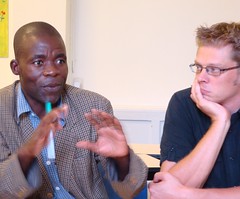
This week, a group of KM4Dev participants in Brussels gathered in an ‘AgHuddle’ to explore knowledge sharing approaches and experiences in agriculture. On the afternoon of the second day, the group was asked to use social media to share out and discuss their findings.

Since the group contained various Twitter users, we decided to set up a time-bound twitter chat where the group of people in the room could quickly share experiences and insights ‘live’ with colleagues elsewhere. We called this process a ‘twiddle’ – that merged the use of TWItter with the face to face huDDLE.

Time from the initial idea to action was short, so the twitter users quickly called on their followers to join a discussion in 60 minutes time, and proceeded to help 4 new twitter users sign up and get ready to twiddle.

For some 45 minutes on 7 October, the twitter users in Brussels shared the face to face AgHuddle findings with colleagues from Addis Ababa, Brussels, Cali, Rome, and Washington DC.

As the flow of messages (retweets removed) shows, it was a lively discussion that added value to the face to face discussions, helped get the main ideas documented, and provided a chance to hear views and reactions from beyond the room. It was also a lot of fun.

A side effect from the face to face element in Brussels was the way the Twitter newcomers and oldtimers shared practical Twitter tips.

More on the AgHuddle: addictomatic or socialmention; a wordle picture

The Twits: @gaurisalokhe; @peterballantyne; @charlesdhewa; @rsamii; @ednahkaramagi; @sna_km; @ekekondo; @asabajf; @stefdeprez; @simonestaiger; @Bajan_Nads; @cdn; @mongkolroek; @pbrolley; @agchat; @jschunter

Labels: , , , , , ,

06 July 2009

Knowledge sharing in agriculture and development

In October 2009, the KM4Dev community organizes its next meeting in Brussels...

One of the 'huddles' will be on knowledge sharing (and knowledge management) in agriculture.

Sign up to the KM4Dev community of practice if you work with KS or KM in international development - and with an agriculture/rural focus.

Labels: , , , ,

02 July 2009

Social media tips for agricultural research

Social media is online content created by people using highly accessible and scalable publishing technologies. - wikipedia

Meena Arivananthan of the CGIAR ICT-KM Program recently published 10 blog posts introducing different social media and how she and her ICT-KM colleagues are using them.

Here's the full set:
More IAALD blog postings on social media

ICT-KM knowledge sharing toolkit

ICCO - Euforic web2 toolkit (en français

Labels: , , , , , ,

22 June 2009

Knowledge sharing 'principles' for agricultural research

Simone Staiger-Rivas recently published a series of blogposts and reports from the CGIAR Institutional Knowledge Sharing Project.

Following from earlier postings on this blog on knowledge management and data management 'principles', her report sets out 10 Key Lessons that could perhaps be seen as emerging principles in this area:
  • When introducing KS, start with a small project and with people willing to experiment. Getting early wins and finding the right people in the right context is important.
  • A successful intervention needs funds as well as explicitly mandated staff with the right skills and enough time to do the work.
  • Without a specific focus, a KS initiative will grow beyond what is feasible to manage. Setting the initiative’s scope is important.
  • KS enables us to pay attention to how we interact with each other and creates spaces where people can be heard.
  • Formulating strategies using KS principles, tools, and methods allows staff to engage in the process and gives them a sense ownership of the results. This in turn ensures continuity in institutional cultures and facilitates the management of change.
  • To successfully communicate KS principles and methods to scientists, practitioners need to show how KS can contribute to their research organization’s objectives.
  • KS works best when applied simultaneously at the grass roots and the leadership level. Senior management buy-in is critically important for integrating KS principles, methods and tools into meetings.
  • KS tools are not enough. To be successful, the KS Project needs champions to advocate for it and continue the work.
  • It is important to build institutional capacity in KS principles and methods. In-house expertise will increase effectiveness of meetings and lead to mainstreaming KS within the institution.
  • KS works best when it is integrated into the organization’s overall business plan, alongside communications and other activities, not as a separate department.
In this video interview, Simone argues that introducing knowledge sharing into a research organization requires attention to three entry points: The first is 'strategic' - making decision points more horizontal and participatory. The second is to work on concrete tools and approaches that staff can work with. The third concerns capacity building and staff empowerment. For knowledge sharing to really happen, an organization needs to "change profoundly."

Labels: , , , , , ,

20 March 2009

Social media for agricultural science?

Looking back on 20 years of the world wide web, the Economist reports on the original "bland title' of a document written by Tim Berners-Lee in March 1989: "Information Management: A Proposal." It argues that "his proposal, modestly dubbed the world wide web, has fulfilled the implications of its name beyond the wildest dreams of anyone involved at the time."

The short article illustrates ways that scientists are "using the web to further their research." However, it suggests that scientists have "tended to lag when it comes to employing the latest web-based social-networking tools to open up scientific discourse and encourage more effective collaboration."

"Scientists publish, in part, because their careers depend on it. They keenly keep track of how many papers they have had accepted, the reputations of the journals they appear in and how many times each article is cited by their peers, as measures of the impact of their research. These numbers can readily be put in a curriculum vitae to impress others.

By contrast, no one yet knows how to measure the impact of a blog post or the sharing of a good idea with another researcher in some collaborative web-based workspace."

CIAT's Simone Staiger recently shared a presentation to colleagues on the Potential of Social Media for Improving Organizational, Project and Personal Impact in an agricultural research institute. She invites them to join the social web, to increase their 'impact pathways' by increasing their networks and reaching out to more users.

Such social approaches were one of the features of the recent Rome sharefair; they were also used to report on IAALD's 2008 World Congress.

They are thus spreading among agricultural information, knowledge and communication people. However, demonstrating the personal and professional 'business case' for social media in science is going to be an important step towards wide adoption of these approaches and tools.

Labels: , , , , , , , , ,

12 January 2009

The participatory web – New potentials for ICT in rural areas

GTZ have just published a report on the potential of Web 2.0 as platforms for networking and knowledge exchange in agriculture and rural development.

The report brings together several contributions: An introduction and overview from GTZ, an introduction to NABUUR's peer-to-peer platforms, a reflection on innovation systems and web 2.0 by Peter Ballantyne, the web 2.0 stories of the Kisan blog in India and Radio La Luna in Ecuador, a profile of ETC work with farmer-led Documentation, an exploration of mobile phone use by Cambodian farmers, and an article on the CGIAR's Knowledge Sharing ToolKit.

IAALD President Peter Ballantyne's contribution concludes:

"Where information and knowledge in agriculture once comprised rather linear processes managed by specialists, tomorrow’s harvests will spring from more organic approaches where innovators of all types become active creators and managers of information and knowledge. This is already happening as researchers and farmers become bloggers, extension workers build wikis, and librarians become film makers. Underlying it all, the new ‘social’ Web 2.0 acts as a catalyst for people to interact, for knowledge sharing and communication to flourish and for innovators to connect and act together."

Download the full report (pdf)

More web 2.0 posts on this blog

Labels: , , , , , ,

26 October 2008

CGIAR knowledge sharing in research project aims to enhance research impact

At last week’s workshop to discuss how improved communication can help maximize the impact of agricultural research in Africa, we caught up with Nadia Manning-Thomas of the CGIAR.

She leads the ICT-KM 'Knowledge Sharing in Research Project' that aims to integrate knowledge-sharing approaches into the different phases of the research cycle - instead of seeing it as an optional 'add-on':


She explains that the approach is based on improving the impact of research along the whole cycle. It shows how undertaking knowledge-sharing can help to achieve other research objectives, such as enhanced relevance; multi-stakeholder engagement; collaboration along the cycle, dissemination and uptake, and M&E:


One key lessons she draws from the project is the need for "bridging individuals" with a variety of skills who can work within research, from the beginning to the end of the research cycle:


The Addis Ababa workshop is organized by the Global Development Network (GDN) in partnership with the Overseas Development Institute (ODI), the World Bank Institute (WBI), and the International Food Policy Research Institute (IFPRI), with support from the Information and Communications Technology – Knowledge Management (ICT-KM) program of the Consultative Group on International Agricultural Research (CGIAR).

Photos from the workshop
Video interviews at the workshop
more stories on this blog / on euforic blog / on ICT-KM blog
Euforic news on communication and knowledge-sharing
R4D news on research communication

by Peter Ballantyne

Labels: , , , , , , ,

02 July 2008

Getting web 2 into use in agricultural research

IFPRI's Pete Shelton shares three lessons from IFPRI efforts to get its researchers to use web 2.0 tools:

1. Focus on the job, not the tool.
2. Researchers like hearing from other researchers.
3. Don’t assume you know what researchers need - go out and ask them!

The full posting explains the stories behind the lessons ...

Labels: , , , , ,

17 June 2008

NewsforDev: CTA aggregator helps track newsfeeds and more

CTA recently announced a new service for development practitioners. NewsforDev employs RSS and e-mail news technology to bring together knowledge and information for development practitioners. It cleverly tracks 600 plus newsfeed to create a number of thematic dossiers on topics like:
Each dossier presents recent content from a number of sources; A nice featire is that you can also subscribe to feeds and updates on each dossier or feed.

A very nice example of the way that information specialists can 'mash' together existing information services in an accessible format....

Labels: , , , , ,

23 May 2008

del.icio.us

In the 'web tastings' blog, IFPRI's Pete Shelton explains the potential of social bookmarking tools like del.icio.us. Seems he forgot, then re-discovered it!

He explains several ways it can help our day to day information management, pointing to its use by Euforic and IAALD.

It's funny how related stories seem to appear at the same time - the ICT-KM blog also has an interesting posting to the use of del.icio.us in research!

Labels: , ,

04 April 2008

More on IAALD blog metrics and use

In September 2006, we published a posting on IAALD blog metrics and use. We were proud to record 7,851 unique visitors and 18,500 page loads in our first year. How are we doing now?

For this blog in 2007, 'StatCounter' recorded 36,000 page loads and 12,800 unique visitors (28,800 page loads and 10,800 visitors in 2006).

Our RSS feeds and email alerts (that combine the blog posts with del.icio.us tagged items) were viewed 78,800 times in 2007, generating 2,500 clickthroughs to news items (this is sure rise in 2008 as we already recorded 22,000 views and 3,000 clickthroughs!).

What are you reading? See the most viewed blog postings and feed items (at April 2008).

Where are visitors coming from?

ClusterMaps shows a truly global readership, except China, large chunks of Russia and Brazil, and some parts of Africa. Strong concentrations in North America, Europe, South Asia, Australia, and parts of Africa.

'Google Analytics' lists the top sources of visitors so far in 2008: USA (23%), Netherlands (8.5%), India (8.2%), UK (4.5%), France (3.5%), Italy (3.1%), Canada (2.9%), Philippines (2.7%), Kenya (1.8%), Colombia (1.7%), Germany (1.4%), Australia (1.4%), Nigeria (1.3%), Costa Rica (1.2%), Iran (1.1%), Ghana (1.1%), and Malaysia (1%).

This all seems to show steady, growing, interest in the issues covered, and an increasing willingness by some people to sign up to email alerts and RSS feeds. Another very noticeable trend is the massively increased visits to some blog stories that follow when an email message is sent out to IAALD members announcing recent postings.

IFPRI's Pete Shelton recently blogged on the impact of web sites, giving "a few potential indicators for measuring impact on the web while trying to provide my own impressions on their overall value and utility for measuring impact."

Tags:

Labels: , , , , , ,

03 April 2008

Blogging web 2.0 and KM for agriculture and rural development

Sometimes you find an excellent new blog on aginfo and related issues and wonder how it didn't come across your radar before... Anyway, Web Tastings is by IFPRI's Pete Shelton and Stephan Dohrn - writing in their personal capacities. The idea is to "reflect on the usefulness and impact of the social web and its tools and approaches on development cooperation."

A recent post that caught the eye looks at measuring impact on the web - and some experiences from IFPRI.

Labels: , , , , , , , , , ,

10 January 2008

Knowledge management for agricultural innovation in Bolivia

A paper in the December 2007 issue of the KM4Development Journal explores how different agricultural innovation projects in Bolivia promote different modalities of knowledge management.

Two of the cases involved multiple KM agents (in an innovation system) and results show that these are "relatively more successful than traditional technology transfer projects." "Projects that promote traditional technology transfer and do not tap into the capacities of a mix of actors appear to be less successful."

Results also indicate that the adoption of innovations by an individual farmer is partly "determined by the knowledge management modalities of the project" as well as the "degree of embeddedness of the farmer in local innovation and learning networks."

The starting point for the work described was the recognition that knowledge "cannot be easily generated in research organizations, and passed down to extension services and development projects which diffuse it among farmers." Different, more participatory multi-actor models of communication, knowledge sharing and learning are needed. In Bolivia, SIBTA (the Sistema Boliviano de Tecnología Agropecuaria) has experimented with different ways to "diffuse technological innovations among small farmers propagating the concept of markets for local knowledge." Some of the projects supported by SIBTA were the cases for this article.

The paper shows that farmers need intensive relationships with many different sources of advice and knowledge, rather than relying on a 'single-source' agent. This implies that farmers need capacities to 'manage' the various different sources. According to the authors, promoters and financiers of agricultural innovation should "foster interactive learning among farmers and other agents" ... setting up of knowledge exchange and learning platforms, and providing access to the creation and communication of tacit knowledge.

Tags:

Labels: , , , , , , , , ,

03 October 2007

Web 2.0 for participatory development: Notes from Rome

This three day conference at FAO from 25-27 September provided an opportunity for participants to share experiences in the use of social networking technologies (i.e. blogs, wikis, feeds, mash-ups etc.) to build collaborative knowledge organizations (www.web2fordev.net).

With a focus on support for rural community information needs, the conference attendees also explored issues of the digital divide, local ownership,linguistic challenges, illiteracy, privacy, capacity building, information overload, and potential delivery mechanisms such as mobile phones and email alerts.

Selected presentations included a demonstration of RSS feed technology used by the Global Forest Information Service (GFIS) gateway; the use of semantic wikis at ICRISAT to build a repository of re-usable information objects; IFPRI’s experiments with improving both internal and external communication using blogs, wikis, RSS feeds, and social bookmarking (see also the china conference web site); and Oxfam's MySpace community engagement.

The experiences of BROSDI, a Ugandan NGO, were striking. It works to improve rural livelihoods through the use of ICTs and knowledge sharing. The BROSDI website provides farmers with weather information, concise FAQs,and access to open source tools for text-messaging. Village knowledge brokers are trained to facilitate two-way communication and to build ICT capacity among all village members, including school children.

For more Web2forDev conference details, go to the conference blog or visit this posting on .

contributed by Barbara Hutchinson

Tags:

Labels: , , , , , , , ,

17 September 2007

AgInfo communities gather in Rome

This coming last week of September promises to be hectic as hundreds of people working with agricultural information, knowledge, ICTs, and the web gather in Rome.

The centerpiece of e-agriculture week is the web2forDevelopment conference. Originally conceived by CTA, Web2ForDev 2007 is the first conference devoted to ways in web 2.0 can be used to support networking, collaboration and knowledge exchange in agriculture and rural development.

The programme has a mouth-watering array of speakers and experiences - Agricultural Market Information Systems 2.0; Web 2.0 for Rural Communities; Drylands Resources Knowledge and Practice Network; Village to Village Knowledge Sharing; Climate Change Mashups; GFAR 2.0; E-agriculture 2.0 in the Pacific; Rural community 2.0 in Uganda; GFIS Forest Informaiton Gateway; IFPRI 2.0; and more ....

As is perhaps appropriate with web 2.0, all kinds of other events and groups are buiilding their own applications around the Web2ForDev platform. The CGIAR information management and information technology managers with hold a meeting just before; also meeting in advance are a group of experts reviewing ongoing developments of semantic standards as well as participants in the 2nd Expert Consultation on International Information Systems for Agricultural Science and Technology.

On the 25th, the 'E-Agriculture Working Group' continues its discussions of post-WSIS actions. The 26th sees a get together of partners in the Global Forum on Agricultural Research community. The IAALD Board meets on the 27th.

Finally, the 28th sees two quite different discussions. The CGIAR convenes an open face to face session [invitation]as part of its discussion on 'Opening Access to CGIAR Research and Knowledge.' On the same day, PROLINNOVA hold a smaller event to investigate 'Farmer-led documentation: Local knowledge sharing in an agricultural context.'

It all promises to be a jam-packed week. We aim to cover some of the discussions through this blog. The Web2ForDev blog is already active in the run up to the discussions and will contain reports from all the presentations. A good way to see some of the resources mobilised is through the 'web2fordev' tag on delicious.

Tags:

Labels: , , , , , , ,